
The Tuesday Review
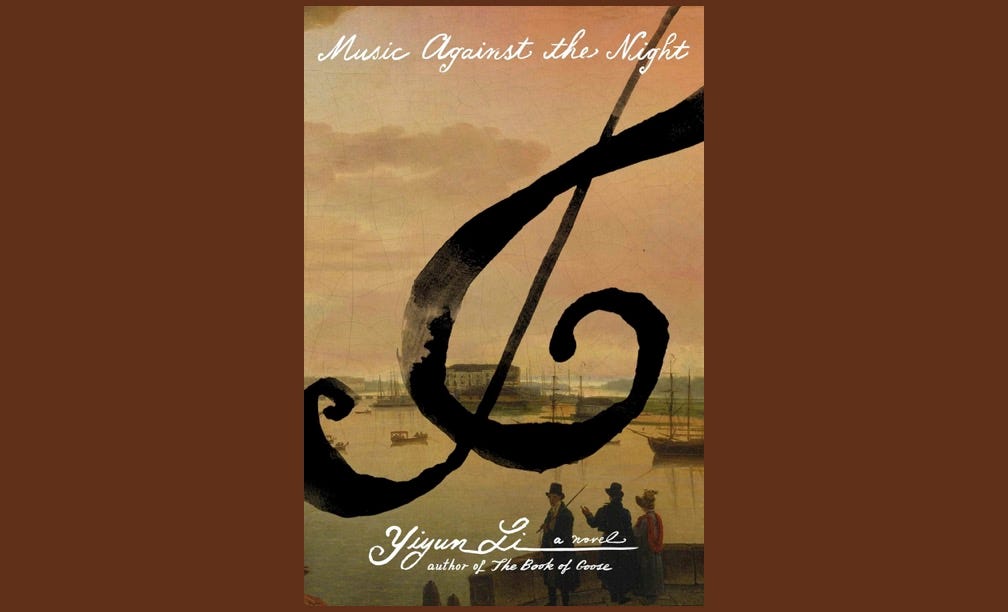
In the opening of Music Against the Night, Yiyun Li claims, “If someone were to write John Field’s biography, it would be a meager volume, and Adelaide, his estranged wife, would occupy only a few lines.”
How brilliantly this historical novel exposes that lie.
You may not have any of Field’s songs on your iPhone, but halfway through War and Peace, Countess Rostova asks someone to play a Field nocturne on the harp. He was, for a time, hot. In the decades after the French Revolution, the Irish composer wowed audiences across Europe, inspired Chopin, and taught Mikhail Glinka, the founder of Russian classical music.
But history has dealt Field its cruelest blow — not opprobrium but oblivion. His reputation hung in the air only a little longer than his last chord. Asked about his faith on his deathbed, Field reportedly muttered, “I’m not a Calvinist, but a claveciniste.”
Hearing that quip, a sympathetic character in Li’s novel says, “The world will remember his wit.”
Strike two.
Music Against the Night, the first volume of a planned trilogy, is a story of tireless ambition told in the wake of implacable effacement. Its tragedy is foretold, but its pathos is no less moving, its verve no less astonishing.
The scene opens in Dublin during the 1780s. Young John has been identified early by his father and grandfather — both musicians — as a prodigy. What unfolds is something like Battle Hymn of the Tiger Mother in E-flat Major. “If you want to be the next Mozart, you’ll have to be at least twice as good as he is,” his father tells the 10-year-old boy.
Everything depends upon John’s success, nay, his triumph. His siblings’ needs, the family’s finances — the entire household is bent to serve the cultivation of John’s talent, which must turn a profit as quickly as possible. It’s an obsession that obliterates any ordinary sense of childhood, quarantines him from his peers, and leaves him desperate to succeed. Fully invested in his father’s fantasies, every night he prays, “Please, God, make me famous as soon as possible.”
Li, who grew up in Beijing and immigrated to America in 1996, never pushes the point, but there’s an eerie contemporaneity to this grasping tale. John’s desperation to perform — a wee boy in a white wig! — and his preteen obsession with managing his public persona grimly anticipate our social media era. His panic about producing a sufficient number of compositions will resonate with any exhausted Substacker. The “likes” of our day are not so different from the tickets sold in John’s. “Those who rely on numbers to measure their accomplishment,” Li writes, “must face constant defeat by numbers.” Noted.
And that may be the crux of this harrowing personal disaster: John is remarkably talented and continues to succeed for years, but when the divisor is infinity, the quotient of one’s life will never amount to anything.
Meanwhile, five thousand miles away in Pondicherry, French India, a clever little girl named Adelaide Percheron is cultivating her own ambitions. We know from the preface — and Field’s biography — that she will one day be John’s alienated wife and sardonic widow. In these alternating chapters, we see Adelaide constructing the skiff that will eventually transport her away from her extended family.
Like John, Adelaide has a devoted grandparent who takes a special interest in teaching her how to succeed — and how to appear successful, which is half the battle. But for a young woman, particularly “a half-breed and an orphan,” the curriculum is strikingly more demanding and steely. Adelaide’s governess has a hard sense of the world: “Don’t ever set your heart on happiness,” she warns. “Only idiots do that, as though they’re not miserable enough.” And so, if John must struggle to inhabit the persona created for him, Adelaide must fight to assert the persona she has created.
The symphonic nature of this novel — the elaborate movements that eventually resolve — is rapturous; the great upheavals of Europe in the early 19th century rumble in the bass line. In elegantly extended sections, Li shifts back and forth between John and Adelaide’s early lives while death claws at almost everyone they know. Li, who lost both her sons in their teens and won a Pulitzer Prize earlier this year for her memoir, Things in Nature Merely Grow, has a brutal awareness of the precariousness of life, the ease with which everything precious to us can be swept away.
Ironic parallels continue to stretch between the determined boy of whom everything is expected and the resourceful girl of whom nothing is expected. One seems pampered, the other imperiled, but they’re both “adrift without a home.”
It’s a journey made all the more engaging by Li’s narrator, who draws us through these adventures with Dickensian wit and judgment. Consider just a few of the many aphorisms laced through the pages:
Words are like music notes, wounding some people and yet leaving barely a scratch on others.
A child who would not be spooked by the beauty and the beastliness of the world would never become a musician.
Wars were like love affairs: only the current one mattered.
But who is this oracular narrator who expounds so confidently on the vicissitudes of human experience, who can lay her hand on any historical detail across the Napoleonic era?
She can move so close to these children that we hear their breath through the cruel calculations of need and desire. But there’s such kinetic energy here, too. In a moment, she’ll bound decades ahead, coaxing out the details of some distant event that boils the children’s dreams in poignancy. And yet every element of suspense that’s burned away early only makes the novel hotter.
Even Li’s digressions — which are legion — never feel digressive, so deftly does she turn these footnotes to grace notes. Who wouldn’t follow her down a two-page rabbit hole about some comically obscure object like the portrait of Signor Clementi’s dull wife?
By the time John and Adelaide meet for the first time, far from their birthplaces, and he asks, “Who are you?” we understand them so well — their passions, their fears, their greasy manipulations — that we know just how perfect they are for each other. And how doomed. It’s that rare literary experience that puts us in the position of some ironical god powerful enough to hear these notes but too weak to do anything but sigh.◆
Music Against the Night, by Yiyun Li (Farrar, Straus and Giroux, 352 pp., $29)
Previous review: Partita, by Barbara Kingsolver (read)
A former piano prodigy confronts the life she lost — and the life she built instead.
Ron, your reviews continue to be a work of art in their own right. Thank you for gracing us with your experience of this novel, which I cannot wait to read.
John Fields music is more than listenable. He is a sad figure in music history, perhaps not tragic, but SO Irish. His piano concerto is elegant. [Is there more than one??]
This, BTW, is an elegant review. I always feel more literate when I read what Mr. Charles has to say.