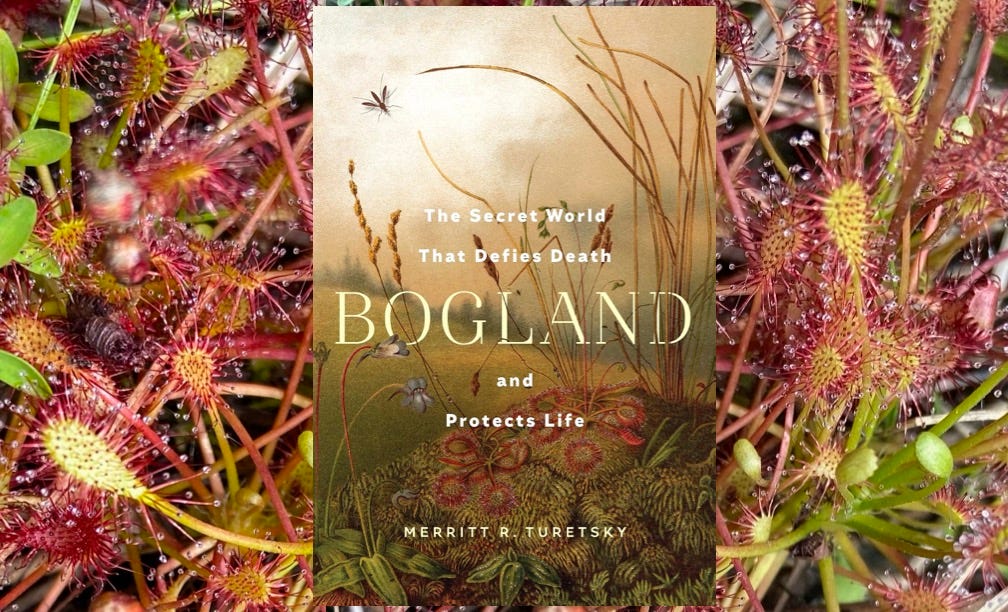
The bog near my father’s farmhouse in Andover, New Hampshire, is a deathtrap, particularly if you’re two centimeters tall.
Bog Pond — named by some strikingly uncreative soul — is actually more pond than bog, but the battle continues. Although it looks as peaceful and divine as Walden, its shores, padded with layers of sphagnum moss, aren’t so much soft lips as a hungry maw.
Paddle through the lilies till your canoe hits the mucky bottom and releases bubbles of methane gas you can blame on your companion. Push yourself a few feet farther along the nutrient-poor shallows. There, at the point where water and earth remain in stalled negotiations, you’ll see them clinging to the wet moss: sundews.
The little plants hold their glistening palms of red tentacles in the air like aliens at a tent revival.
Insects attracted to those shiny drops of mucilage find themselves stuck. As they struggle, the tentacles slowly gang up and curl around for a deadly embrace.
Digestion might begin even before the kidnap victim is dead. The leaves secrete enzymes that dissolve the bug’s body, and the plant absorbs its precious nutrients.
Darwin was fascinated by sundews. So gruesome and diabolical is this plant that Blake might have asked,
Sundew Sundew, burning bright,
In the forests of the night;
What immortal hand or eye,
Could frame thy fearful symmetry?
But the bog’s gang of weird killers extends beyond these delicate sundews.
Get out of the canoe and step carefully onto the spongy shore. Try to find purchase on a log, or you’re likely to sink down to your knees and go home — if you ever go home — without your shoes. Hidden at first but then seemingly everywhere among the sweet gale bushes are bulbous rosettes of pitcher plants. Their veiny green and purple leaves gape open toward the sky like hungry koi.
Insects and even small amphibians that venture inside these inviting ewers encounter walls covered with tiny hairs all pointing down, down, down toward an ounce of rainwater and digestive fluid just right for drowning.
Imagine that moment of realization, when delight slips to concern, then panic — then the letting go.
Edgar Allan Poe himself could conceive of nothing more macabre.
In her new book, Bogland: The Secret World That Defies Death and Protects Life, Merritt R. Turetsky writes, “It is often said that nature is soothing medicine to the human spirit — to which bogs scoff and offer us something very different.”
Is it any wonder that bogs undulate in some of our spookiest tales? “These places do not conform,” she writes. They’re as close to the surreal as nature gets. “Bogs occupy the borderlands of the solid and the submerged, vitality and decay, allure and discomfort, refuge and risk.”
Bogland is a work of natural history, cultural analysis, and memoir that challenges our dismissal of these damp spots. It’s that rare book that gives roots to my lifelong fascination with a murky realm of salvation and murder.
While taking us on her soggy adventures around the world, Turetsky explains the essential role that bogs play in regulating the Earth’s climate. For millennia, layers of sphagnum moss, “the world’s largest and most effective sponge,” have been absorbing carbon dioxide and locking it away in slowly accumulating peat. “The future of bogs,” she writes, “will influence the balance of greenhouse gases in the atmosphere for centuries to come.”
We’re draining, filling, and burning these essential ecosystems at an alarming rate.
If you know how to read them, those billions of tons of peat serve as a history book of weather and pollution, not to mention an archive of ancient boats, tools, and anything else that might have been dropped accidentally — or purposely — into these anaerobic depths.
Among the most fascinating parts of Turetsky’s book is her discussion of people buried in bogs since at least the Neolithic period. Some bodies show signs of torture and trauma; others appear to have been revered — and possibly sacrificed. We know nothing of their individual lives, but a few corpses are so well preserved in this acidic tomb that archaeologists can tell what they ate for their last meal (porridge and fish) and even reconstruct their clothing and jewelry.
The discovery of a woman’s skull in Cheshire, England, provoked a man to confess to killing his missing wife before scientists determined the skull was about 1,800 years old.
“Bogs are landscapes of quiet menace,” Turetsky writes. Even experienced field researchers can get disoriented. Once, she started following a meandering animal trail she mistook for her path back to a sample site. How close she came to joining the bog bodies.
But bogs are a refuge, too. Over the centuries, Indians, rebels, deserters, and enslaved people have fled into this swampy fastness to escape punishment or death.
Emily Brontë knew that refuge, as Turetsky mentions near the end of Bogland. For Catherine and Heathcliff, the ill-fated lovers of Wuthering Heights, the Yorkshire moors provide a sanctuary commensurate with their passion.
Turetsky’s unlikely mission is to make us all feel that fervency for bogs, to make us realize we can’t live without them any more than Heathcliff can live without Catherine.
Bogs may suffer from our mistreatment, but they won’t go meekly. They’re not the passive victims we imagine. In their extremity, they could release millennia of stored carbon back into the atmosphere, drawing us down, down, down.
Imagine that moment of realization, when carelessness slips to concern, then panic — then the letting go.◆
The rest of the newsletter follows below:
Books Go to the Movies and Back Again
Wicker, based on Ursula Wills-Jones’s short story “The Wicker Husband,” opens today in theaters. Academy Award winner Olivia Colman stars as a lonely fisherwoman who orders a husband from a basketmaker. Alexander Skarsgård, who’s played everything from vampires to robots to Tarzan, is her reedy mate. (Tor recently released the story as an ebook.)
Klara and the Sun, starring Jenna Ortega and Amy Adams, is rising to some particularly scalding reviews (trailer). The movie, based on Kazuo Ishiguro’s 2021 novel about an earnest robot and her young human owner, has been dismissed as “a sentimental and laborious mess” by the Guardian. The Independent suggests that director Taika Waititi drives “a clown car through a novel.” What a shame; Ishiguro’s delicate story, the first one he published after winning a Nobel Prize, relies on the kind of hauntingly implicit prose that the big screen can crush so easily.
I’ll Believe in Anything: The Making of Heated Rivalry Season 1 (The Annotated Scripts) debuted this week at No. 1 on the nonfiction bestseller list. The book, by creator/screenwriter Jacob Tierney, is based on the Crave/HBO Max hockey romance series, which is adapted from the gay romance novels in Rachel Reid’s Game Changers series. Season 2 of the TV show is expected next year. The seventh novel in Reid’s series will be released in June 2027.◆
Don’t Sweat It
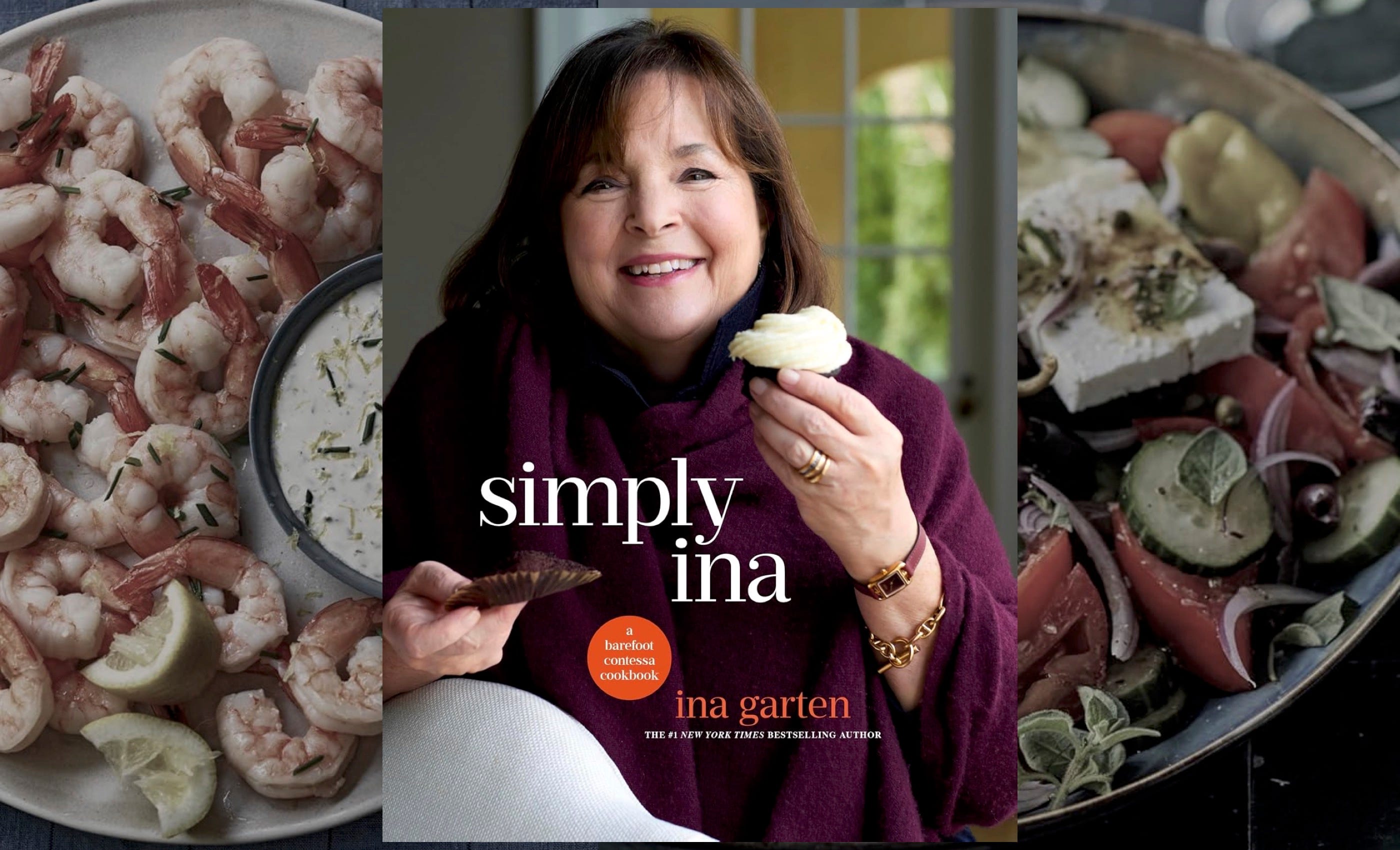
Simply Ina, the new cookbook by Ina Garten, has attracted two of the most reliable fans I can imagine: Ann Patchett and my wife.
In August, Ann told me to get an advance copy; in the kitchen, Dawn told me to give it to her.
I can see why. This gorgeously produced cookbook is filled with lush photos of Sesame Ginger Chicken Bowl, Chipotle Maple Mashed Sweet Potatoes, and something called a Cherry Clafoutis (which I must have!). Credit for the images goes to the tastefully named Quentin Bacon.
With the holidays approaching, this could be the cookbook to whip up some variety for your guests. But it might also make a great gift for someone starting off in their own place because Garten’s overriding principle is simplicity.
Ina may be the anti-Martha. She’ll never tell you to start preparing a salad by peeling 500 fresh peas that you grew in your own cold frames constructed with wood taken from remnants of the Mayflower.
“When I was teaching myself to cook by working my way through Julia Child’s Mastering the Art of French Cooking I struggled with fancy techniques like ‘cook in a bain-marie,’” Garten writes in the introduction. “But after decades of cooking, I’ve learned something far more important: the best food is often the simplest.”
Garten’s even willing to sneak in store-bought pasta sauce and pre-shredded vegetables. Intimidated by making your own cheesecake? Buy a good one and spruce it up with a quick raspberry sauce. Who’ll know?
Suggested menus at the end help cooks and hosts plan a get-together.
“Simple food shouldn’t just save you time,” she writes. “It should let you enjoy the people you love.”◆
Underlined
A periodic feature highlighting a passage from something I’m reading.
(RN is France’s far-right National Rally party.)
Xenophobia, and the creation of resentment and fear, is RN’s absolutely indispensable stock-in-trade. It is not ever likely to go away. And a party that attracts supporters through xenophobia and encourages the scapegoating — the demonisation, if you like — of communities of immigrant origin is never going to be itself effectively dedemonised.... Next year voters in France will have the chance to give their judgment on how trustworthy or how respectable a party RN is. Many of the inheritors of Gaullism have already, by their hopeful visions of a comprehensive unity on the right, given their approval to the far right’s dédiabolisation. The several million mostly left-wing voters who stayed away in the second round in 2022, asserting that, between Macron and Le Pen, it was “impossible to choose between the plague and the cholera,” were also, perhaps in spite of themselves, endorsing dédiabolisation. Next year all of the French will have the opportunity to think again, and to choose again. If they care enough, it is not too late to prevent the worst.
From “The Dark Side of France: A History of the French Far Right from the 1890s to the Present,” by Enda O’Doherty (Liveright, Oct. 13).◆
Arrested Development
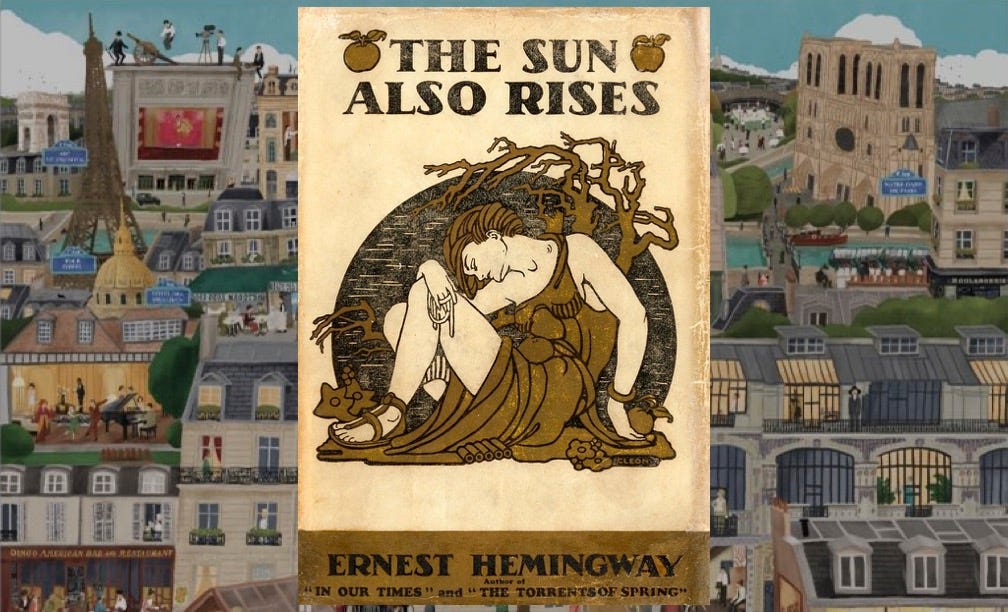
This week, The Sun Also Rises celebrates its 100th anniversary. It is, to my mind, Hemingway’s finest and most enduring novel. He published it at the ripe old age of 27, when he was already in the throes of ruining his first marriage.
I remember this because Dawn and I fell in love while taking a Hemingway seminar. (And then years later, Dawn and our professor worked at the same condom distribution company, but that’s another story.)
The Sun Also Rises was the product of a remarkable collaboration between Hemingway, Fitzgerald, and their editor Maxwell Perkins.
While praising the manuscript, Perkins told Fitzgerald that Hemingway’s book was “almost unpublishable.” Fitzgerald — already a famous author of three novels and many short stories — counseled his younger colleague to resist anything careless, ineffectual, and wordy. Hemingway subsequently cut the first two chapters of The Sun Also Rises. By Christmas, the novel had already sold out two printings.
It’s an abiding lesson in the value of subjecting one’s opening throat-clearing, which often sounds so clever, to harsh interrogation.
You can see this play out in The Annotated Sun Also Rises, a new volume from the Library of America, edited by Robert W. Trogdon. It contains some 140 illustrations and photographs along with marginal notes that provide historical, geographical, and biographical context.
Despite its strikingly constrained plot, there’s so much in The Sun Also Rises about honor and endurance and the avoidance of self-pity. And when I was teaching, it didn’t hurt that the book offered a god-awful example of what a drunken social life can become. Though, honestly, now that kids are so shockingly isolated and lonely, I’m not sure this new Lost Generation is any better off.
Thames & Hudson has produced a 1,000-piece jigsaw puzzle called Hemingway’s Paris. Illustrated by Max Dalton, it shows dozens of artists and scenes. There’s Josephine Baker dancing in the Théâtre des Champs-Élysées. Hemingway and Fitzgerald meet up at the Dingo American Bar. And Cole Porter plays the Charleston for his guests.
An accompanying poster with text by Matthew Holman reveals the whole moveable feast.
Would you like this puzzle? Be the 100th person to send me an email with the subject line “Isn’t it pretty to think so?” (email)◆
Picture This
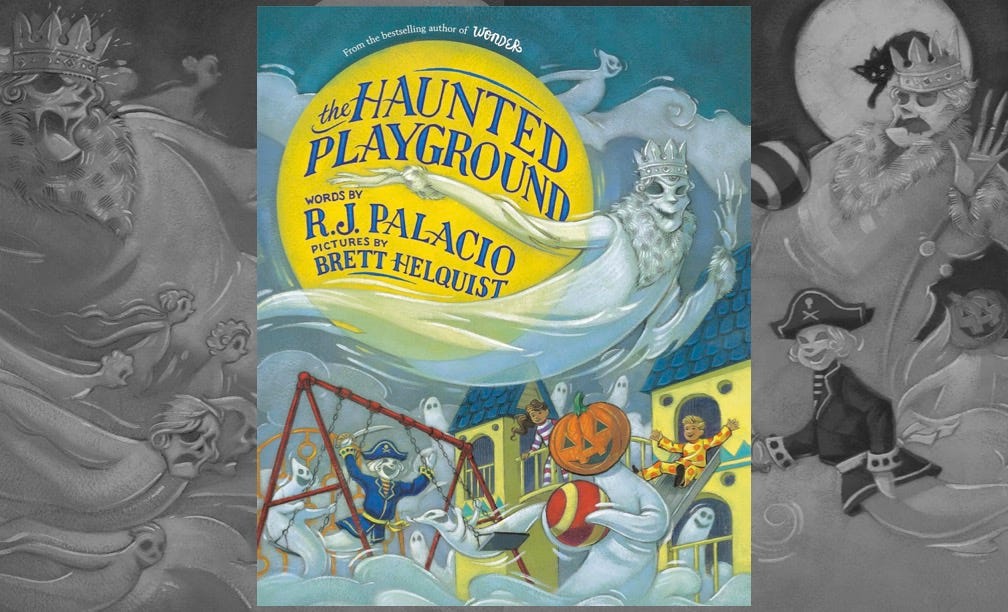
Ghosts just wanna have fun. That’s the theme of an elaborate picture book called The Haunted Playground, written by R.J. Palacio.
In a long series of galloping rhymed quatrains, Palacio tells the story of Rex Magnificus, who gathers spirits from across the world to play on his “mysterious, fantastical playground” every Hallow’s Eve.
They’re here because they want to laugh,
to frolic and be merry.
They’re here because they need to take
a break from being scary.
Trouble is, a pair of kids who live next door wake up and wander into this merriment. The King of the Ghosts is outraged, “for children aren’t supposed to see / this midnight jubilee!”
It turns out Rex Magnificus has a lot to learn about kids, and the kids learn something sweet about him, too.
So, at last, to my chagrin,
I shrug and just give in.
I play their games all through the night —
I even let them win!
Brett Helquist’s stormy illustrations strike a delicate balance between spooky and fun for readers ages 4 to 8. This is a terrific book to thunder aloud while little ones fall into these lush scenes.◆
This Week’s Poem
Mihaela Moscaliuc was raised in Romania under Nicolae Ceaușescu’s deadly and absurd regime.
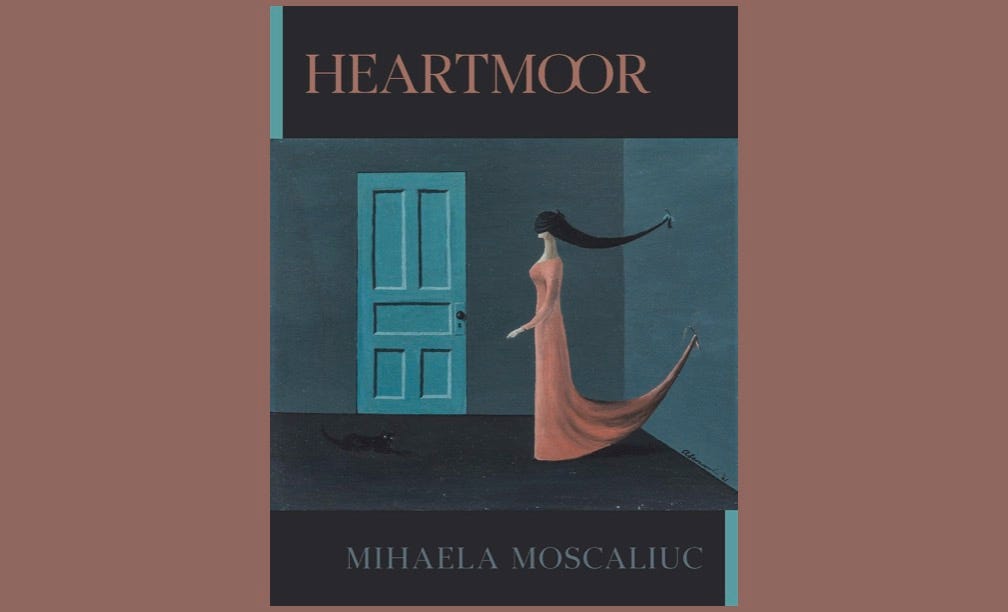
Heartmoor, her fourth collection, reflects the trials — and moments of stolen joy — in a life shaped by dictatorship and exile.
“Extractions,” an extended prose poem, describes the Handmaid-like horrors of living in Romania when pregnancy was coerced by the state and abortion was illegal. The piece was inspired, if that’s the right word, by the overturning of Roe v. Wade in 2022.
In a later poem she writes,
I was so hungry when I arrived in the promised land.
I binged, then lined shelves with Campbell’s
in the event of another dictatorship.
Escape from such repression is never easy, or complete.
By Chocolate
I will die one day in this land
and you will fly back a single bar of me
packed in dry ice.
The airport dogs will sniff the carousel
for traces of live matter
and the cacao-nutty smell
will send them whimpering.
Make sure I’m conched right:
neither too gritty nor too emulsified,
tempered properly
so I’m not laced in sugar bloom.
The already departed will attend to the rest.
For seven years, on days of the dead,
birthdays, anniversaries,
drive your family to any cemetery gate
to hand out dark assortments
your children bagged the night before.
Keep the tradition
even if no one is ever waiting.
If I’m lucky, they will say
grandma overdosed on nibs,
and make myth of this.
From “Heartmoor: Poems.” Copyright © 2026 by Mihaela Moscaliuc. Published by Alice James Books, 2026. Reprinted with permission of the publisher. All rights reserved.◆
Golden Anniversary
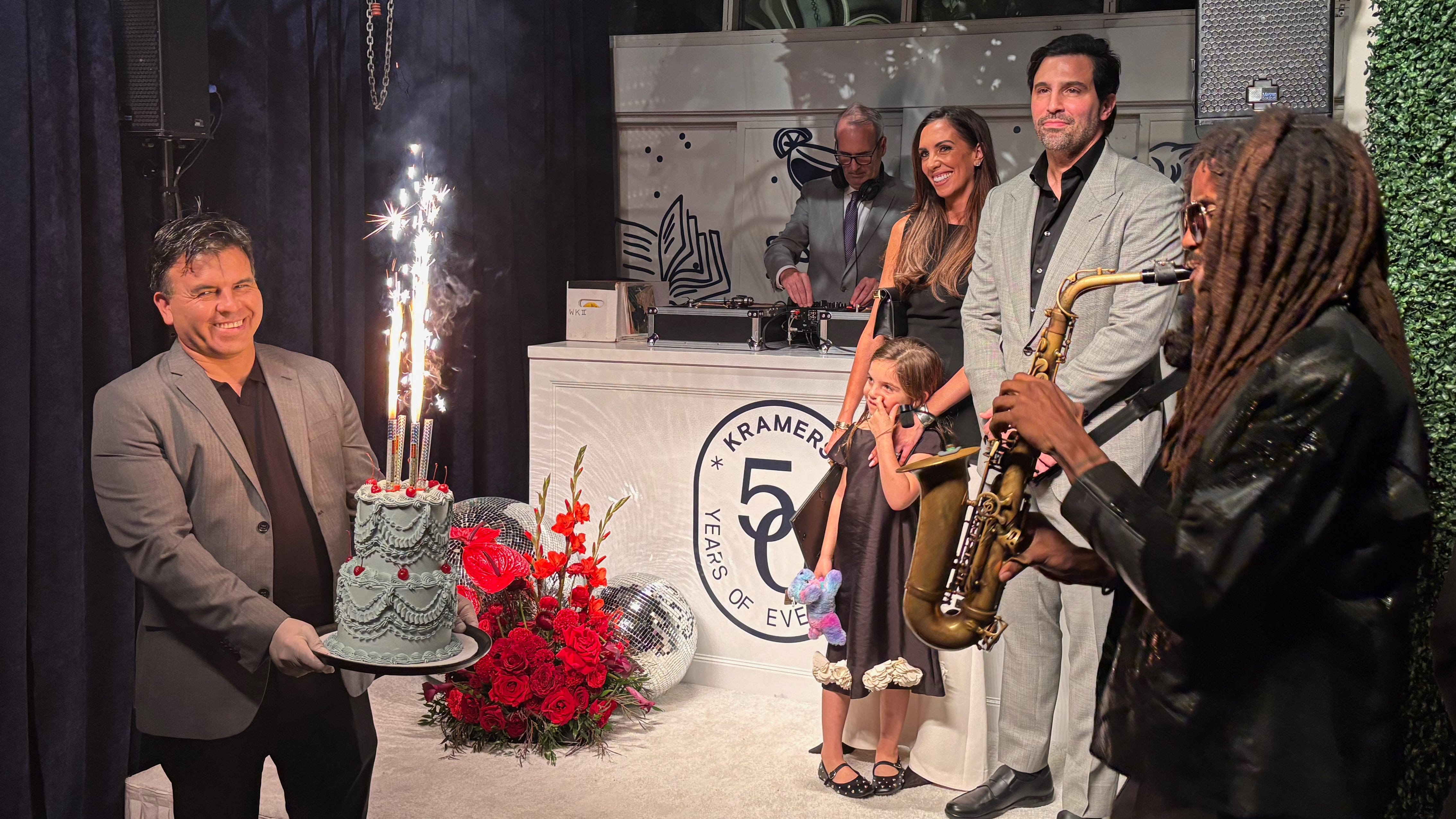
Yesterday, for the first time anybody could remember, Kramers bookstore closed down.
But — wait — this is a happy item: The temporary closure was for the store’s 50th anniversary party.
Steve Salis, who acquired the storied Washington bookstore in 2016, told his guests, “Buying Kramers was the only time I’ve ever done a business deal without thinking about the numbers. I knew I was being handed something very special.”
Salis recalled some of the lives that have intersected at Kramers in Dupont Circle.
“Presidents and poets, artists and celebrities, dreamers and hopeless romantics, and millions of people have come through these doors,” he said. “First dates have turned into marriages. Readers have discovered books that have changed their lives.”
D.C. Mayor Muriel Bowser dropped by to present a proclamation declaring Oct. 22, 2026, Kramers Day.
In our goodie bags — a Kramers book tote, naturally — we got bookstore-scented candles with hints of leather, paper, mahogany, and joy.
Here’s to the next 50 years.◆
Clippings
Last week’s review examined A Dead White: An Argument Against White Paint, by Wendy S. Walters (review).
Isabel Allende won Spain’s Premio Planeta de Novela for La hora antes del alba, a sequel to her bestselling debut, The House of the Spirits, published in 1982. The award, worth a little more than $1 million (!), celebrates an original, unpublished novel written in Spanish.
Pizza Hut is offering two dozen free Little Free Libraries to eager hosts across the country. These “Little Hut Libraries,” complete with distinctive red roofs, come filled with 25 new books and a pack of pizza gift cards. Applications are open till Oct. 31. Apply here.◆
Ah, geez, I had decided not to get the "Bogland" book because I already have too many books and can't read them all in whatever's left of my current lifetime.... But then you have to go and write this beautifully eloquent review (your best review ever??) so I have no choice but to change my mind and get this book. I will put it at the top of the "to read soon" pile, which contains a fair number of other books you have reviewed. You are the best bad influence I have ever encountered. Thank you!
Incidentally, if you'd like to try raising carnivorous plants at home in a terrarium, I've ordered plants from https://carnivorousplantnursery.com/
(I've also found Venus flytraps at Trader Joe's.)