Do I Still Matter?
Two new books — and a lot of free time — got me thinking about how we yearn to matter.

Since I was laid off from The Washington Post on Feb. 4, things have been going pretty well, depending on the hour. In the afternoons, I’m an independent writer with a dream. At 3:47 a.m., I’m an unemployed journalist with a mortgage.
The first week, I lost 10 pounds. It turns out that being laid off is like Ozempic administered via email.
So far, I’ve been doing a Modified George Costanza: I pretend I’m employed but working from home. It’s a Covid-lockdown vibe — upbeat but anxious. Surely, this will be over soon!
Despite the freedom thrust upon me, I’m still reviewing a novel every week as I’ve done for almost three decades. I’m reminded of the tiger that was finally released from the zoo but kept pacing back and forth in front of invisible bars.
A few days ago, Dawn left for school muttering, “How have you managed to make unemployment more work than having a job?”
Having been eliminated or, as the Brits would say, made redundant, I feel like a pilot determined to keep flying after the wings fall off. It is, of course, all about scrambling away from the lip of irrelevance.
I’m not so cocooned in self-pity that I can’t see my relative good fortune. Many folks laid off from The Post — and a thousand companies beyond — are facing far more devastating challenges. But my sympathy for them can’t slake my own thirst for purpose.
It’s always a little disappointing to discover that one’s deeply personal existential crisis is, in fact, in perfect sync with pop culture, like the time I heard myself quoted on Thirtysomething.
But there can be comfort in that chorus. It’s striking that there are two new nonfiction titles on the subject of mattering.
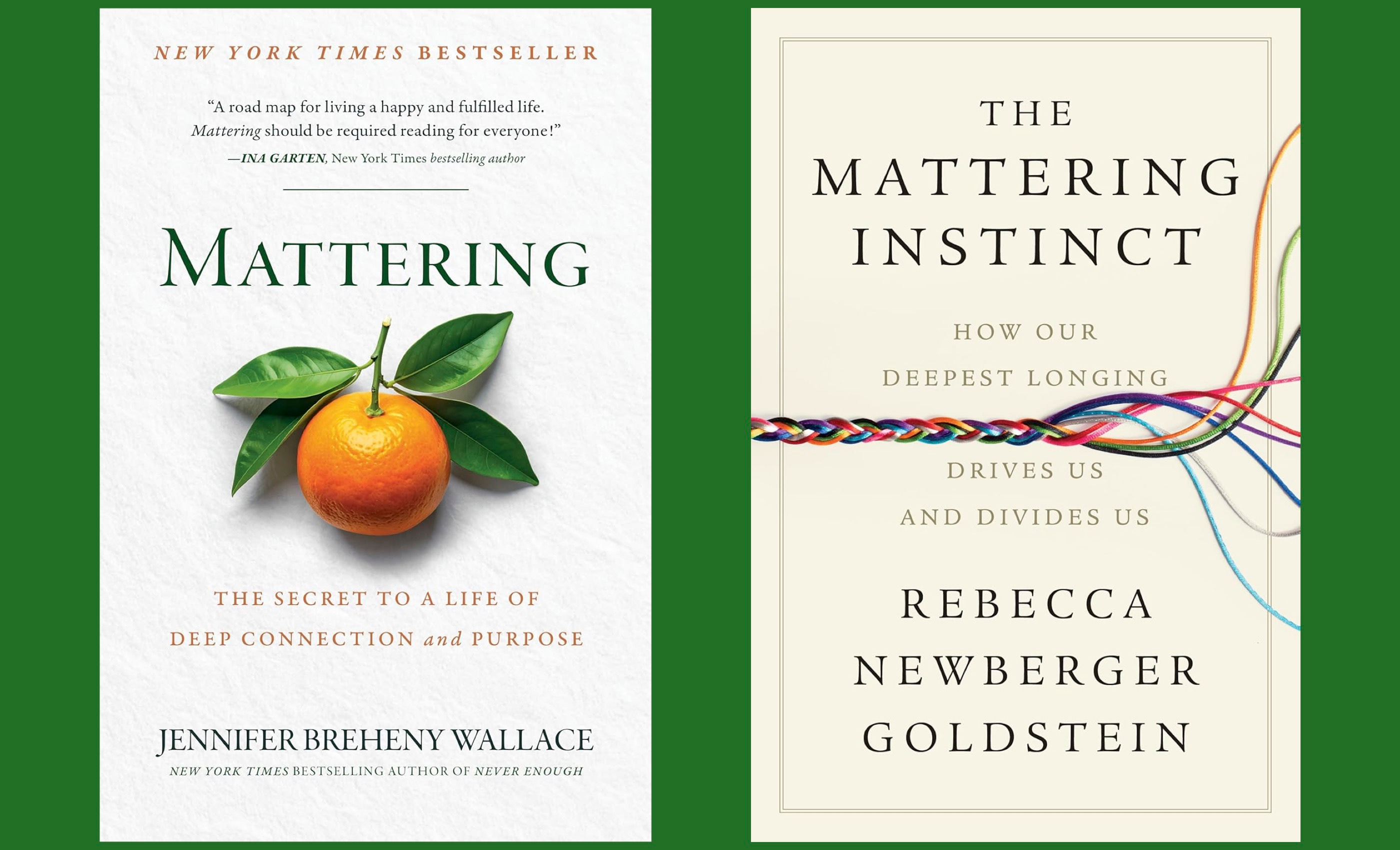
Journalist Jennifer Breheny Wallace has published Mattering: The Secret to a Life of Deep Connection and Purpose.
Wallace’s approach is standard self-help: anecdotal and relentlessly earnest with pull quotes and a slate of jargon to reframe an ancient yearning as a solvable problem. Be a cornerman! Build a mattering core! There are even formulae:
Feeling Valued + Adding Value = Mattering
And yet. Maybe it’s just the severance talking, but something about Wallace’s undeniable sincerity got to me. In her conversations with a firefighter, a sanitation worker, a farmer, executives, educators, parents, and retired people, she’s genuinely curious about how they’ve come to understand that they matter.
Of course, she offers practical steps, too, like maintaining a personal “impact file” for thank-you notes from people you’ve helped. But her best advice for feeling more loved is to love more.
“No matter what kind of upheaval we’re facing,” she writes, “be it job loss, retirement, empty nesting, a shifting world, or some other destabilizing event, the surest way to sustain our own sense of mattering is to focus on making others feel like they matter.”
The novelist and philosopher Rebecca Newberger Goldstein may be playing the same melody, but she’s transposed it from the major key of self-help to the Baroque counterpoint of self-knowledge. Her book, The Mattering Instinct: How Our Deepest Longing Drives Us and Divides Us, stems from work she’s been doing for more than 40 years.
With her elegant style and an omnivorous command of literature and history, Goldstein argues that our desire to matter has spawned religion, philosophy, the sciences, the arts, and politics, in short, all of human endeavor — and much of its conflict.
“We long to demonstrate that the reason we subjectively feel that we matter is that we objectively do. This longing is what I am calling the mattering instinct.”
It’s a fascinating, if at times demanding, exploration of philosophy, theology, and metaphysics. Yes, you will confront phrases like “epistemic elusiveness,” but Goldstein is an experienced professor, always ready to help out. And while her anecdotes often come from the lives of figures like Ludwig Wittgenstein and William James, she also includes stories about people she knows, such as a former skinhead who is now a practicing Jew.
An atheist herself, she has no patience with the glib superiority of some atheists. The urge for transcendence is not, to her mind, silly or unworthy of serious consideration, though she suggests how a sense of cosmic purpose can lead to intolerance.
She posits that the fundamental tension of human life is that “we are creatures of matter who long to matter.” That is, though we’re physical entities subject to the law of entropy, we’re uniquely endowed with the self-reflection to chafe against it, to crave a kind of permanence that lies beyond us.
In Annie Hall, little Alvy Singer stopped doing his homework because, he tells his doctor, “The universe is expanding.”
Goldstein acknowledges that fate. “But meanwhile,” she says, “we can seek to matter by resisting entropy in ways as expansive as possible, allying ourselves with life and not with death, with happiness and not with sorrow, with creativity and not with destruction.”
What are you waiting for?◆
Books Go to the Movies:
In Midwinter Break, an older couple — played by Lesley Manville and Ciarán Hinds — take a vacation to Amsterdam, only to confront past secrets that challenge their relationship. Opening today in theaters, the movie is adapted from Bernard MacLaverty’s Midwinter Break (2017), which The Guardian called “a quietly brilliant novel ... essential reading at any stage of life.”
How to Make a Killing, starring the ubiquitous Glen Powell, opens today in theaters (trailer). The lineage of this comic thriller is almost as convoluted as its plot: The story’s ancestry runs through the 2013 Broadway musical A Gentleman’s Guide to Love and Murder, the 1949 film Kind Hearts and Coronets, and finally lands on a 1907 novel, Israel Rank: The Autobiography of a Criminal, by the Edwardian novelist Roy Horniman.
56 Days, starring Avan Jogia and Dove Cameron, is an erotic thriller about an intense relationship that ends just shy of two months with lots of blood in the bathtub (trailer). The eight-episode series, steaming now on Prime Video, is based on Catherine Ryan Howard’s best-selling novel, which The Washington Post named one of the 10 best thrillers of 2021 (full list).◆
We know the Olympics as the consecrated pinnacle of human endurance and skill. But imagine watching the luge competition for the first time: athletes screaming down an icy track on their backs at 90 miles an hour. Why would anybody do that?
More than 1,800 years ago, a Greek writer named Lucian cast his satirical gaze upon athletic competition — with medal-winning results. His wry dialogue Anacharsis is set in a gymnasium in Athens, where one might catch Socrates pumping iron or using your towel.
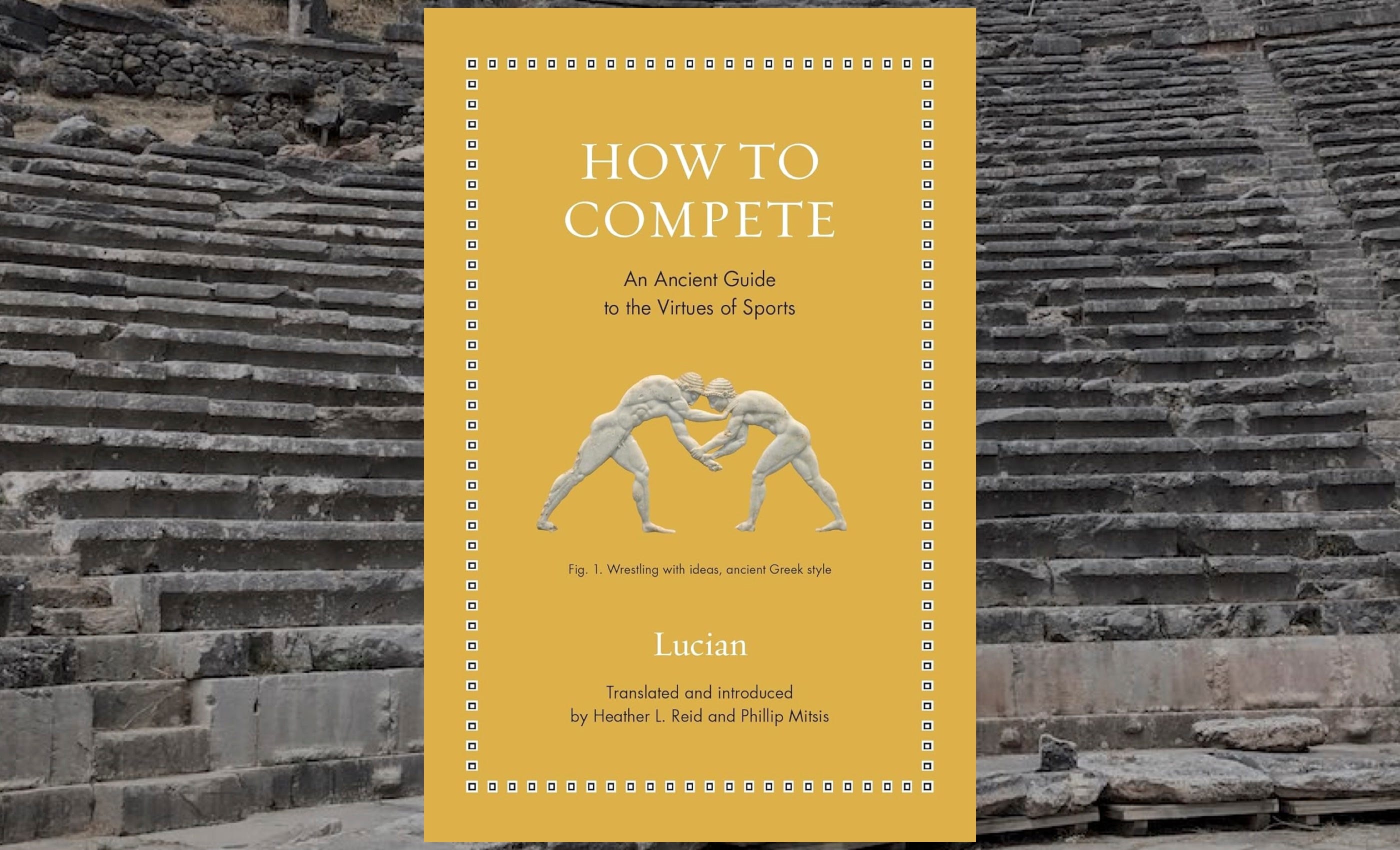
Next week, Princeton University Press will publish a new edition of Lucian’s dialogue titled How to Compete: An Ancient Guide to the Virtues of Sports, translated by Heather L. Reid and Phillip Mitsis. With a helpful introduction and glossary, their translation is so immediate you can feel the athletes flinging sweat into your eyes.
The text opens in medias mess: Naked guys slather themselves with olive oil and then begin trying to kill each other. Anacharsis, a visitor from a faraway place, asks a perfectly reasonable question: “Why are your young men doing these things?”
Thus begins a witty examination of sports that feels uncannily relevant in our own athletics-obsessed era.
“The activity seems more like madness,” Anacharsis says, “and there is no one who could easily convince me that those doing these things are not out of their minds.” If anybody treated him like this, he’d stab them with a dagger.
No, no, his Athenian friend, Solon, responds. This activity is called “wrestling.” It’s an “exercise” that tones the mind and body. And there are prizes, too: “At the Olympics, a crown woven from wild olive.” Others win apples and celery.
Anacharsis is not swayed. He can think of easier ways to get celery than being choked, crushed, and kicked in the stomach.
Solon’s defense relies on the way sports build mental toughness, hone the body, cement a cohesive culture, and refine the military.
Anacharsis snorts. Being hot and tan won’t repel an enemy’s spears.
He also can’t fathom why spectators are willing to waste so much time. “I am not yet able to fully understand what enjoyment they get from seeing people hit and grabbed and then thrown to the ground and beaten to a pulp.”
Like boxers in the ring, Anacharsis and Solon take their best shots for and against the value of athletic competition. It’s a rousing, rhetorical battle that’s still playing out in college boardrooms, newspaper columns, and state legislatures — but never this wittily.◆
Literary Awards and Honors:
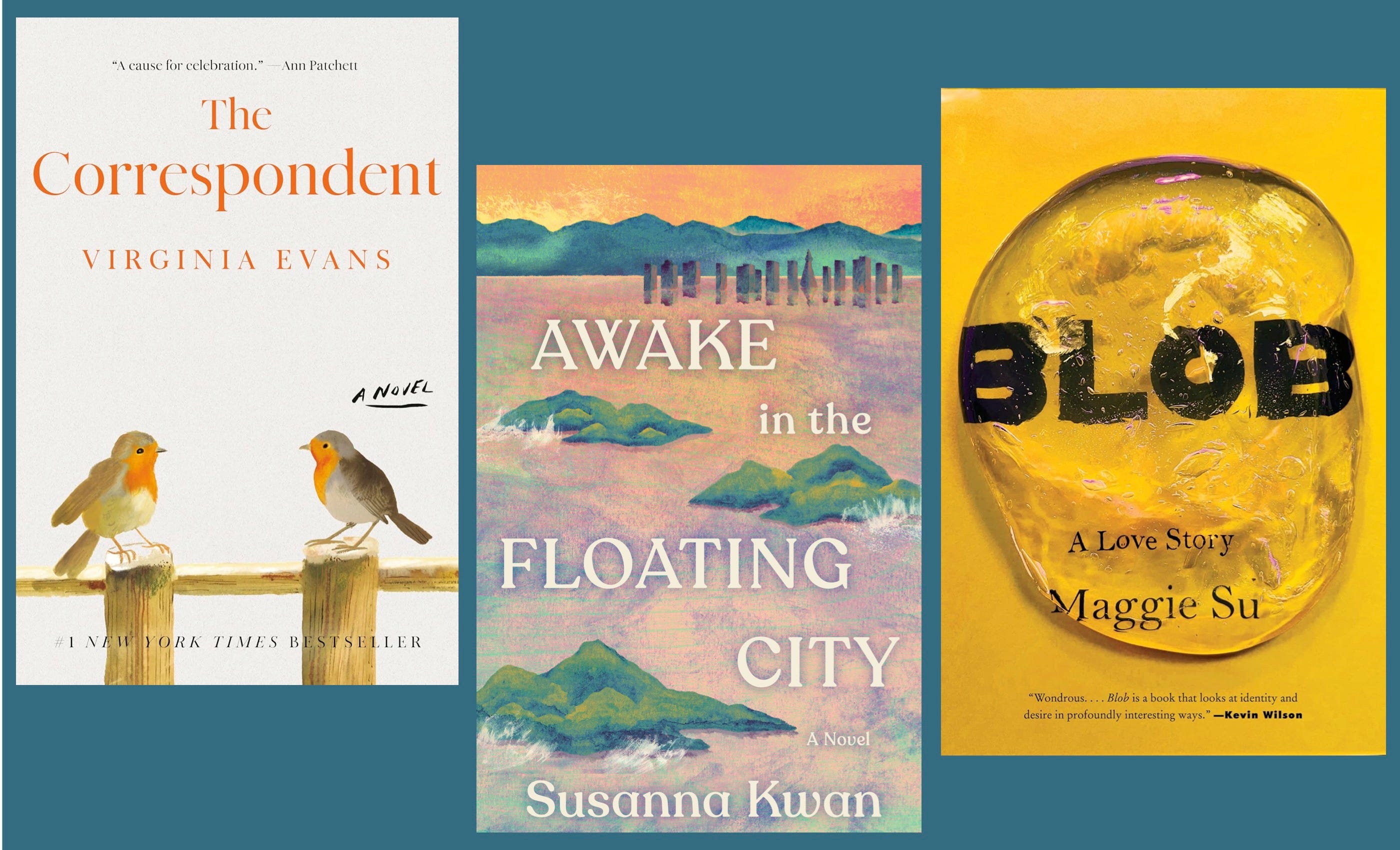
The PEN/Faulkner Foundation has announced the finalists for the PEN/Hemingway Award for Debut Novel: Virginia Evans’s book-club juggernaut, The Correspondent; Susanna Kwan’s climate story, Awake in the Floating City; and Maggie Su’s comic monster romance, Blob. The $10,000 prize will be presented to the winner at the Kennedy Library in Boston on April 26, with a keynote address by Alice McDermott (register).
Hostage, a memoir by Eli Sharabi, has been named Book of the Year by the National Jewish Book Awards (full list of winners). Sharabi was held by Hamas for 491 days after the Oct. 7, 2023, surprise attack on Israel. The Wall Street Journal called Hostage “a book of startling eloquence, unimaginable anguish and exceptionally restrained rage.”
Andy Weir has been named winner of the Robert A. Heinlein lifetime achievement award, administered by the Baltimore Science Fiction Society. Heinlein, who died in 1988, remains a towering if controversial figure in the genre — just a tad too authoritarian and incesty for some folks. Weir, meanwhile, is the computer programmer who initially self-published his immensely popular 2011 novel The Martian.◆
Next week marks the fourth anniversary of Russia’s barbaric invasion of Ukraine. There will be grim stories about the alarming condition of the country, accompanied by photos of Ukrainian families freezing underground, but Americans are at risk of slipping into indifference.
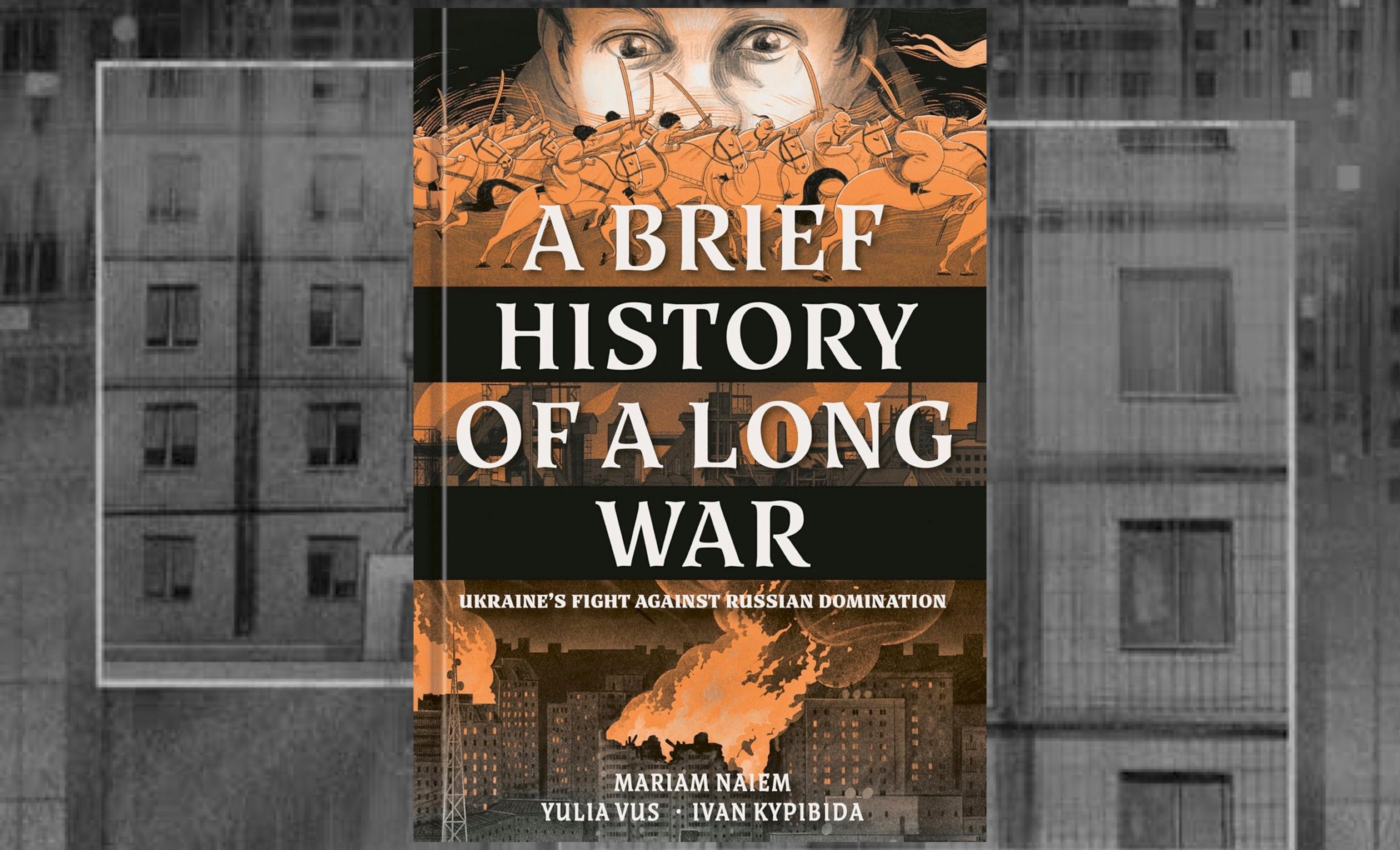
A Brief History of a Long War, by Ukrainian writer Mariam Naiem, is a work of illustrated nonfiction that will awaken and haunt anyone who reads it. Designed as a graphic novel by Yulia Vus and Ivan Kypibida, this decidedly brief history revolves around a young woman trying to survive in her apartment building as Putin’s bombs fall.
Between those frightening episodes, Naiem takes us deep into the past and then begins working through Russia’s historical abuses of Ukraine, including the Holodomor, a famine that killed millions in the early 1930s.
Later pages move quickly but with bracing clarity through contemporary political troubles and Kremlin treachery. “We are not the first Ukrainian generation to die from injustice,” Naiem writes.
The illustrations are dark, limited to a palette of black and orange, and the designs shift perspectives unpredictably.
“We’d like to believe that one day the war will end,” Naiem writes, “that we can plan our future and leave fear and bombardment somewhere long ago in the past.”
That won’t happen if the West allows Putin to erase another country, one town at a time.◆
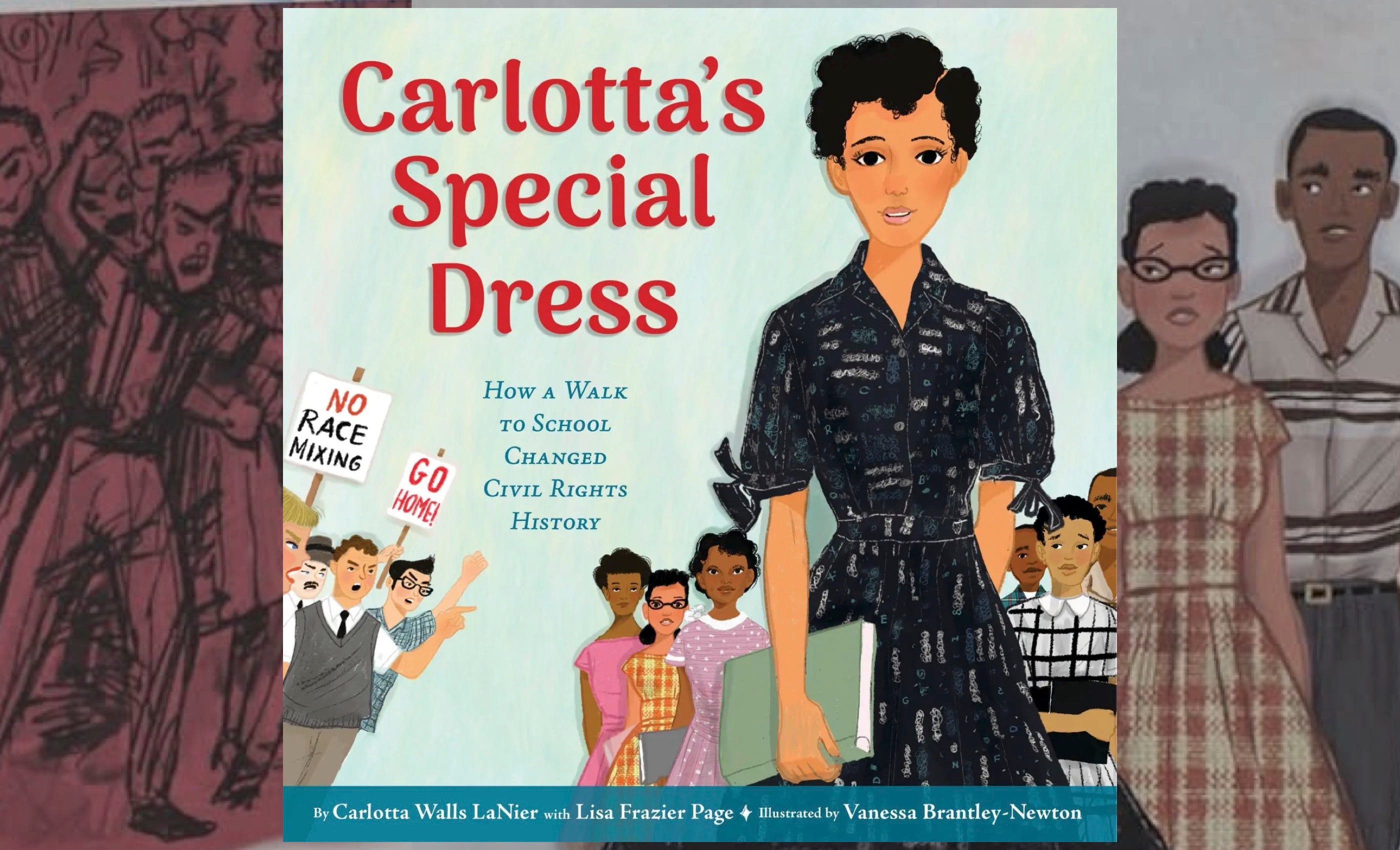
Picture This. Carlotta Walls LaNier, one of the Little Rock Nine in 1957, has written a thoughtful picture book for children learning about desegregation (ages 6-8).
Carlotta’s Special Dress: How a Walk to School Changed Civil Rights History begins with a girl excitedly buying a new outfit for the first day of school. But when she and a few other Black students arrive, they’re confronted by a crowd of White people “blinded by rage.”
LaNier retells the events of that contentious time with clarity and detail appropriate for young readers, and Vanessa Brantley-Newton’s lively illustrations are engaging without being frightening.
Near the end, of course, President Eisenhower sends Army soldiers to protect the students and make sure they can enter Central High School.
An author’s note for adults and a timeline make this a useful educational text.
The story of the Little Rock Nine never loses its inspirational power, especially now, when a very different kind of Republican president, emboldened by the Kavanaugh Stop, has twisted the rhetoric of “law and order” to harass and assault people of color across the country.◆
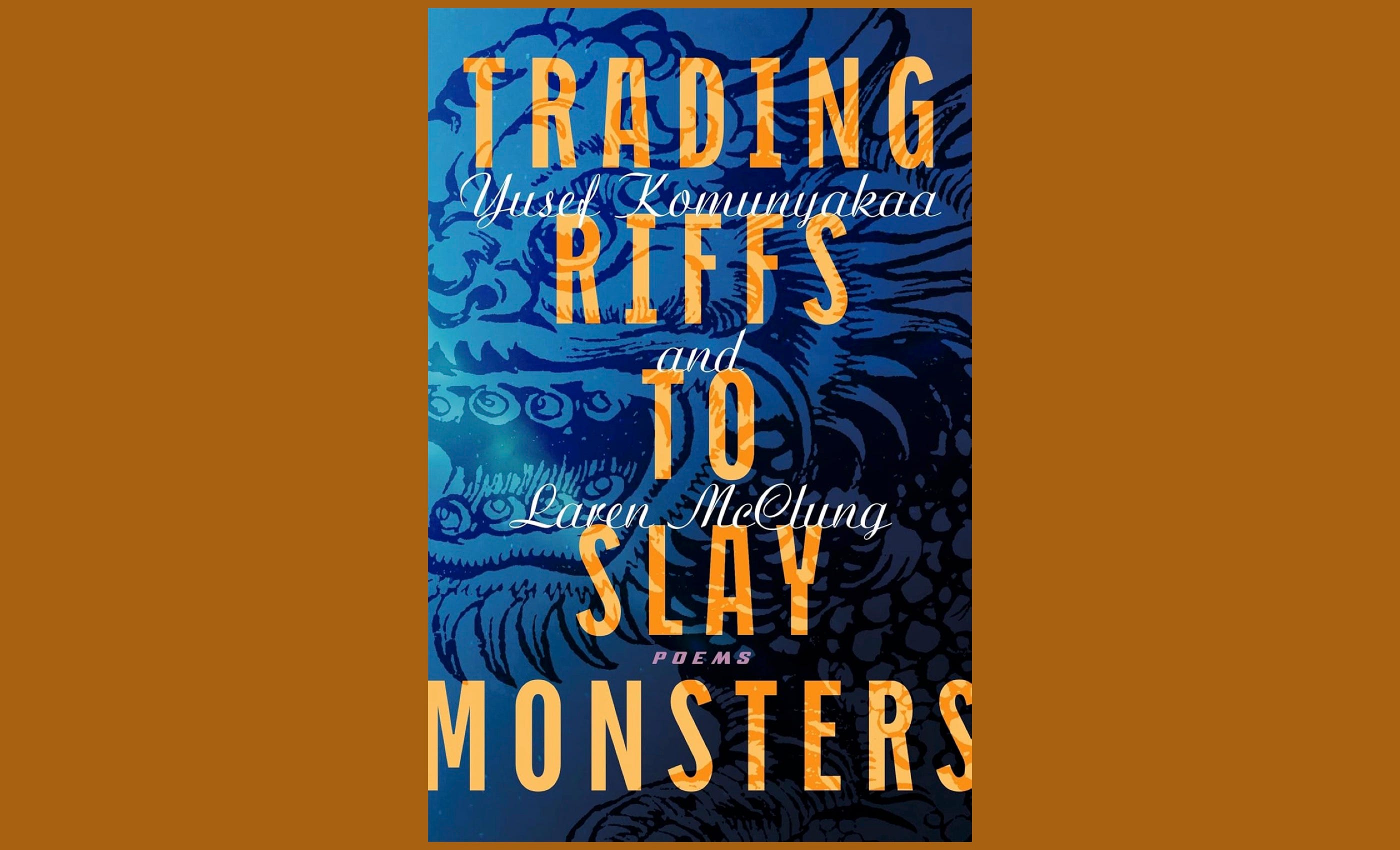
During the Covid pandemic, Pulitzer Prize-winning poet Yusef Komunyakaa and NYU writing professor Laren McClung began a remarkable conversation over email. Letting their minds wander across time and space, they exchanged a long series of tercets that respond to each other in curious ways.
Komunyakaa and McClung have just published their call-and-response verses in a collection called Trading Riffs to Slay Monsters. It feels less like a correspondence than a duet — two voices balancing each other on their way through a landscape of grief, history, and hope.
This excerpt gives a sense of their method and range:
We say John Lewis, & silence that comes afterwards
honors him. One cannot say his name & not think,
How in the world did he take into himself those blows,
old language hurled from the reptilian brain,
& still he could lift his head, then look into the eyes
of his assailant as if to say, It would hurt me deeply
not to be able to forgive you. Today, as his casket
on a mule-train wagon rolled across the bridge,
into Selma, his voice sang along with the others.
I plead the world has learned from him,
Let’s not go backwards towards division but
with every breath make a bridge. Yes, every wordis a chance for peace, every heartbeat a reminder
of time ticking past. Let’s not waste this moment
together in the streets with blows, no. Find a noteto sing all-at-once as if to ring out of chaos & shatter
the glass, then retune ourselves. There’s work
to be done, & we need all hands on deck.
Excerpted from Trading Riffs to Slay Monsters: Poems. Copyright © 2026 by Yusef Komunyakaa and Laren McClung. Reprinted with permission of Farrar, Straus and Giroux. All rights reserved.◆
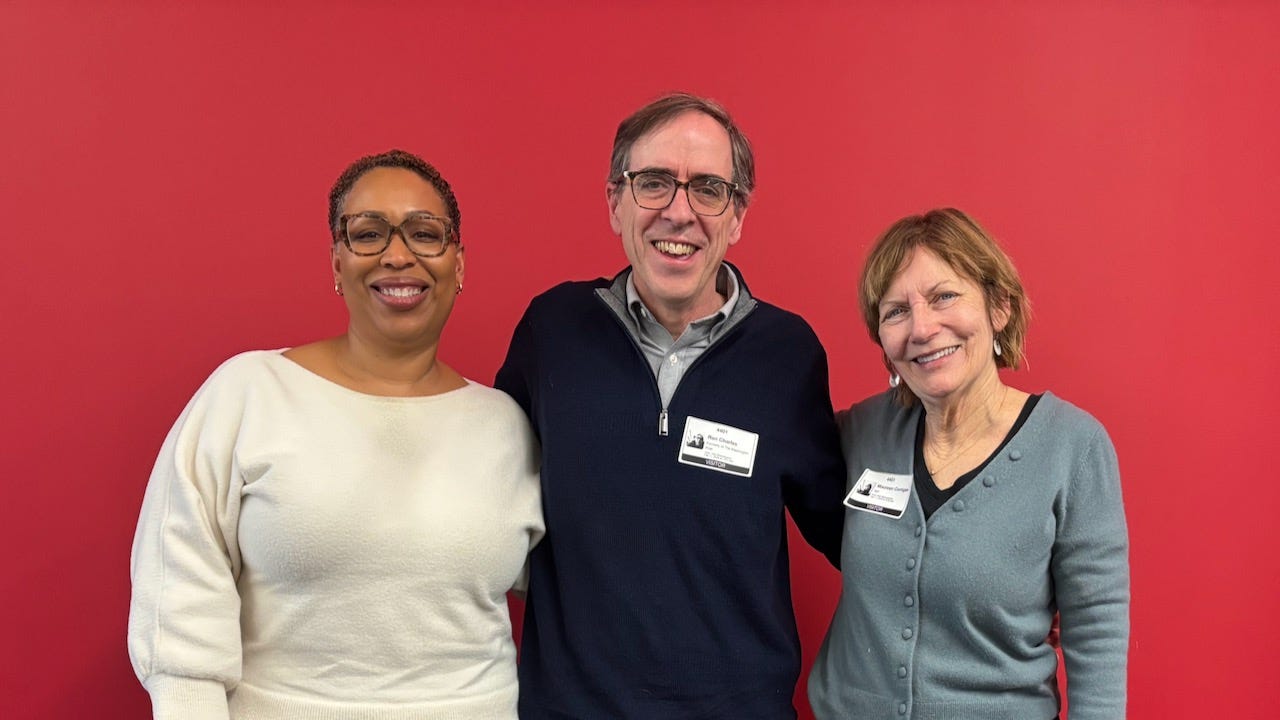
Earlier this week, I was on NPR’s 1A with my friend Maureen Corrigan, the book critic for Fresh Air. Host Jenn White led our conversation about the state of book criticism, and I didn’t tear up even once (listen).
P.S. Plan ahead: The National Book Festival is a little earlier this year: Aug. 22 (details).◆
If you’re enjoying this, please consider sharing it with a friend. Paid subscriptions — even a few dollars a month — make the difference between a lark and a livelihood.
Otherwise, I’m back to selling vegetable seeds door-to-door.
I find that those who matter the most don’t know it. So, along with a nationwide chorus, I give you the good news “You Matter”. How gloomy would the days be without your window onto current and classic books, teaching in our schools (via your spouse), and news of literary gatherings.
You still matter, Ron! Thank you for this terrific newsletter.