M.L. Stedman Is Back — With Another Impossible Dilemma
In “A Far-Flung Life,” the author of “The Light Between Oceans” spins a wrenching tale of love tested by secrecy.

The Tuesday Review
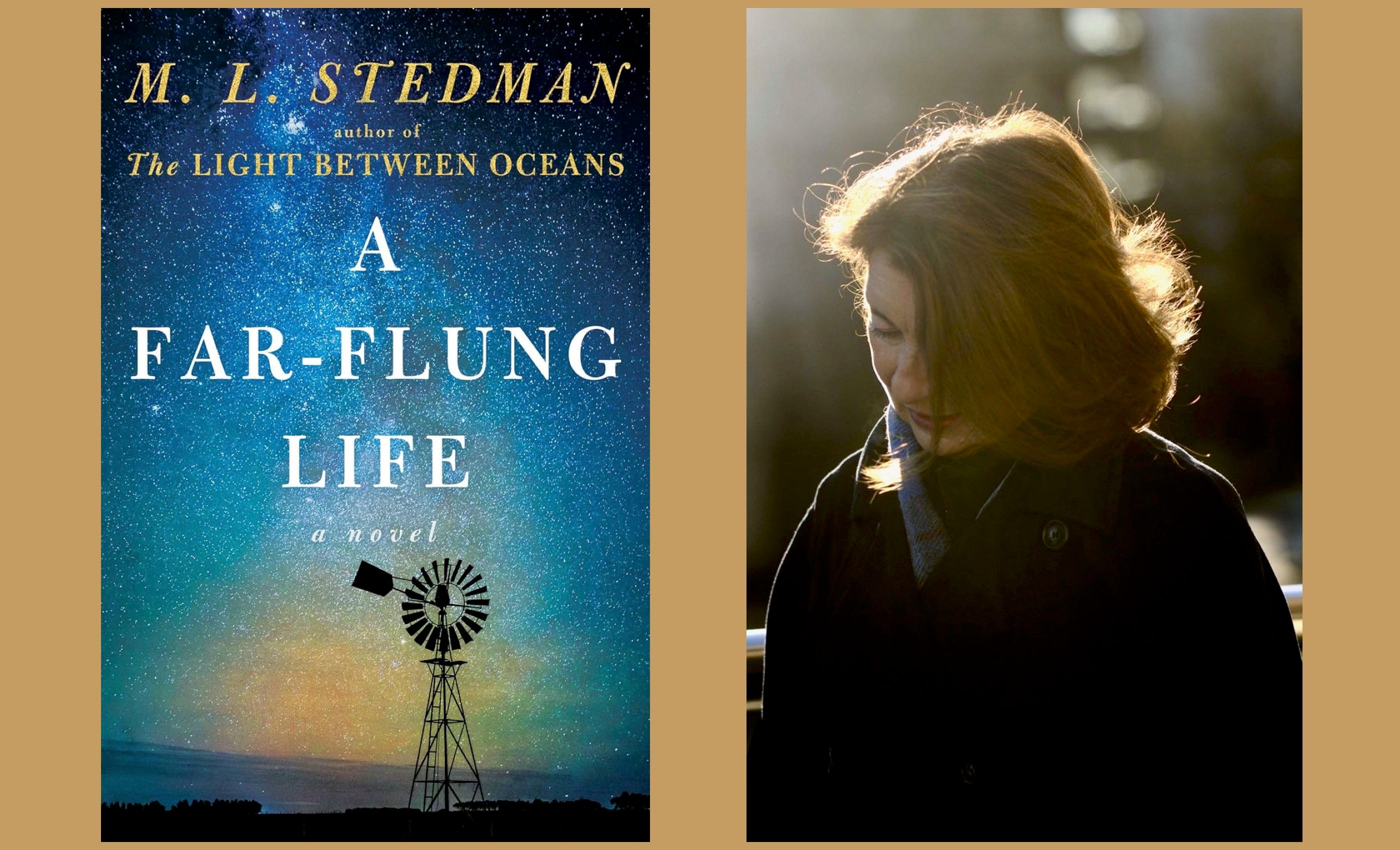
In 2012, M.L. Stedman’s debut novel, The Light Between Oceans, bounded onto bestseller lists around the world like a globetrotting kangaroo. Her story of a couple on a remote Australian island who find an infant became a book-club craze and inspired a movie starring Alicia Vikander and Michael Fassbender.
Now, more than a decade later, Stedman is back with another wrenching, wholly absorbing story about a man caught in the maw of an impossible dilemma.
A Far-Flung Life opens in 1958 with the near-destruction of a proud family, a catastrophe so stunning that it feels like a tale transported from ancient Greece to the Outback. “The MacBrides had the touch,” Stedman writes. “They made ideal neighbors” — not that any neighbors live too close, given that their sheep “station” stretches across a million acres in Western Australia. It’s a miracle, really, that anyone finds the fiery wreck that killed the patriarch and his elder son as they drove along an orange gravel road. Only the younger boy, 17-year-old Matt, survives, though early reports are unreliable.
Crashing into these grand characters’ lives just as they’re smashed or snuffed out makes for a bracing introduction. But it’s characteristic of Stedman’s emotional narrative that ticks through a chronology of happiness and disaster as inexorably as the old grandfather clock in the homestead. This is, after all, a region familiar with ruin. “A light coating of death dusts any scene you care to observe in the bush,” Stedman writes. “Death twinkles in this landscape like mineral sand.”
In such a realm, a long season of good fortune makes for horrible training. Lorna MacBride, the mother of this once-glorious clan, “known and admired for hundreds of miles,” is making a birthday cake for Matt when two policemen knock on the door. They guide her back to the kitchen and gently let her know that the life, the world, she once knew, once considered as permanent as the land, is gone.
A Far-Flung Life initially feels like a novel of mourning — in the tradition of Ayelet Waldman’s Red Hook Road, which begins with the death of newlyweds on the way to their reception. But there’s little time for grief in Stedman’s story, given the exigent needs of the living. Matt, who was entertaining dreams of the future when thrown from his father’s truck, finally awakens in a hospital with severe head trauma and amnesia. The sweet young man everybody knew is replaced by an erratic stranger whom his sister and mother barely recognize.
This is very much a story about “what gets forgotten, how the memory recovers, and what it recovers.” Striking a grandiose mood, Stedman’s plural narrator writes, “Our lives come and go like these gold-rush towns. We arrive, we grow, we thrive, then we’re gone. Then the forgetting happens, and once-solid foundations are barely traces in the earth, from unguessable lives. Whole communities and the ties that bound them are blown away with the dust.”
Matt’s sister — the MacBrides’ only girl and a bit on the wild side — has her own method of hurrying oblivion along: She writes down terrible secrets and then burns the paper with a match. “It goes away,” she claims. “It’s magic!”
That power to erase the truth gets desperately tested in these pages. While Matt heals and remakes his life as a gentle, if taciturn man, he finds himself saddled with a child whose origins he must not reveal to anyone. Such is the tension that Stedman stretches out over years — the potential for happiness constantly threatened by the possibility of revelation. “Time,” Matt knows, “will not be denied its due,” but perhaps it can be successfully delayed.
Stedman is supremely adept at pursuing this theme, as she traces the tragedy of these endearing, painfully responsible characters. And how cleverly that burden is embedded into the very soil of the place. Amid all the other challenges the remaining MacBrides endure as they try to keep their flock of 20,000 sheep alive, a mining company arrives and begins searching for minerals. All across the station, miners are drilling into the earth looking for something valuable, an ominous metaphor for the buried truth Matt dreads coming to the surface. And meanwhile, an implacable police sergeant who sounds like he wandered out of a Henrik Ibsen drama is determined to find the truth no matter who gets hurt by it.
In one sense, A Far-Flung Life has not flung itself too far from the moral dimensions of The Light Between Oceans. Once again, we’re dealing with a baby swaddled in an unspeakable secret, what one character refers to as a “forgetment,” the opposite of a memory. But Stedman has violently torqued the moral axle of this plot. Indeed, Matt is so handsome and so stoic and so photogenically tormented that he seems genetically designed for Jacob Elordi to play in the inevitable movie version. But the intimate details of Matt’s situation may give Hollywood pause. I’ll say no more about that here — some other reviewer is sure to spell out Every. Single. Detail. — but know that this is a boundary-pushing plot.
And just as consciously, it pushes against time, too, rolling over the decades. Taking the sheep shears to some of the hind parts of this novel would have improved its pacing without sacrificing its power. But such is the nature of Stedman’s storytelling that I never resented her a page. This is, after all, an epic about resisting love in the name of love. Length — endurance — is essential to the project. The terror and, yes, the beauty of that struggle burn hotter with each passing chapter.◆
A Far-Flung Life, by M.L. Stedman (Scribner, 448 pp, $30).
Seeing a Ron Charles review again made me very happy.
Glad you’re out there, Ron.