Six Months After the Fall
There is life after The Washington Post — but no IT support.

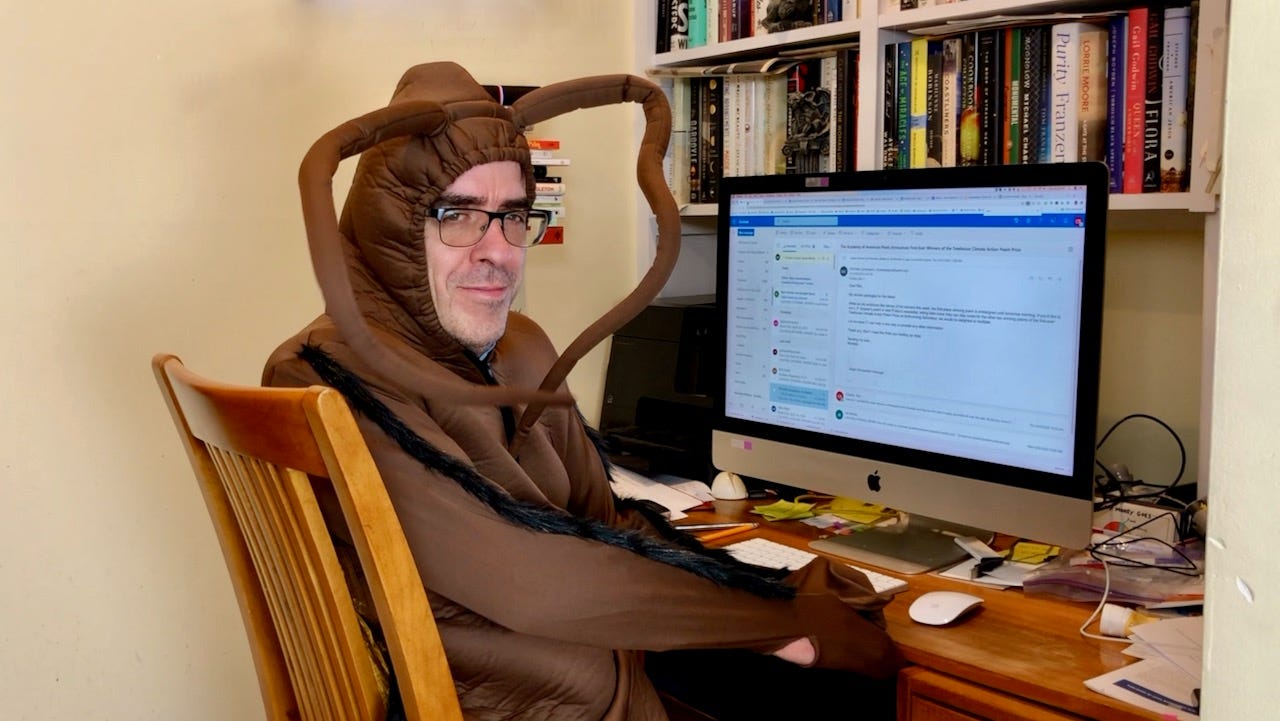
Today is the six-month anniversary of my pivot to Substack. I say pivot — so elegant! — but it was more like being pushed down the stairs.
Last January, everybody at The Washington Post knew trouble was coming, but after surviving so many earlier cullings, I imagined I could once again duck under the swinging scythe and keep writing till they carried out my carcass in a book tote.
That was not to be.
Still, here I am, six months later, with what’s looking like a career as an independent journalist. It turns out there is an audience for reviews — even from an old book critic “riding on a smile and a shoeshine.”
But honestly, my modest success only makes me more disappointed that the world’s richest bookseller and The Post’s breathtakingly incurious and uncreative senior executives wouldn’t help us reach that audience for books coverage.
A Substack subscriber commented on last week’s newsletter, “Reading this feels like an entirely freer piece than what you wrote in Book World. Maybe we should say thanks to Bezos.”
I can’t go that far yet. But I have to acknowledge that my Substack was initially propelled by The Post’s seppuku, which focused national rage on this little corner of the literary world. That’s publicity that money can’t buy.
Indeed, given how hard it is now to attract new subscribers, I need The Washington Post to lay me off every six weeks.
As for my alleged new freedom, I surely have more than I’m exercising. Where I should be a soaring eagle, I’m kind of an errant capybara. The audience here is a lot more flexible than I’ve given them credit for.
I need to be more adventurous about length, approach, and format, both for your entertainment and my sanity. Next month, I might start offering advice on how to get beach-body ready.
I knew almost nothing about Substack when I started, and I’m surprised by how much I’m still learning. It feels like discovering a new closet in a house bought at auction for back taxes. (Unfortunately, I’m also discovering new fees.)
To the consternation of my entrepreneurial brother, I’m relying on the NPR model: Most people read this newsletter for free, while a generous minority keeps the whole enterprise afloat by buying paid subscriptions. Social media companies are masters of ruining themselves at users’ expense — see Cory Doctorow’s Enshittification — but for the moment, this seems like a viable arrangement.
When I started here, I didn’t realize one had to select a name for one’s newsletter, so I just typed in my own. So I’m the creator of “Ron Charles” by Ron Charles, which sounds even more self-absorbed than I really am.
If I’d been required to select a name, I might never have launched. Many years ago when the novelist Meg Wolitzer and I were plotting a podcast, we spent untold months coming up with a name, and the one we liked best was the one we mocked most: Booknanza!
I’m regularly assured of the blessings of working for myself, but I’m not entirely convinced. I miss going into my office and seeing my colleagues, and I especially miss all the help those colleagues used to give me: suggesting new story ideas, correcting my creative spelling, noting where a review isn’t really convincing, warning me that I’ve already used that lame joke twice this year, and warning me that I’ve already used that lame joke twice this year.
Also, as some of you know, working for oneself means doing everything, including promotion (voilà!), editing (thanks, Dawn!), accounting, ordering books, sorting books, and, ultimately, finding someone to take the books away.
One of the greatest challenges is that the border between work and life has grown permeable to the point of invisibility. A project like this allows me to work on my own time, which turns out to be all my time. Feel free to write to me at 2:47 a.m. I’ll be laying/lying? in bed fretting about a grammar error in Friday’s newsletter.
Then there’s the challenge of selecting what to review. At The Post, when I couldn’t fit a novel into my schedule, I could try putting my thumb on the scale and asking one of my colleagues to assign it to someone else.
These days, I find myself writing far too many apologetic notes to publicists and authors (so many authors). Decisions about what to review — or, more frequently, what not to review — have become unexpectedly painful because they remind me just how dramatically the book-reviewing ecosystem has collapsed.
But there are plans, or at least concepts of a plan, percolating around the country. Three ambitious publishers have talked with me about starting new book sections.
That’s exciting but disappointing, too. As my former colleague Becca Rothfeld pointed out in The New Yorker, special book review publications are not in short supply; what we need are book reviews sown in general-interest publications with broad readerships.
How many Substack newsletters does it take to recreate the pleasures of one murdered book section?
If wishes were horses.
On the other hoof, I’ve been delighted by a new relationship with you.
I assumed my connection to readers could run only through cables maintained by The Post. But clearly, that’s not true. Substack offers the chance to hear from readers in real time. You bring an impossibly wide perspective — collectively a million years of reading experience — along with wry corrections, helpful directions, and heartfelt encouragement. I read every note and comment. If I don’t respond to every one, forgive me; I’m trying.
In January, I thought I’d just settle into my desk chair at 1301 K Street like moss on a log. But six months into my new indie career, I appreciate where I’ve landed.
To those of you who have subscribed, thank you. To those of you who have become paid subscribers, I’m especially grateful. You’ve allowed this book critic to reinvent his career — and his life — on the fly.◆
Ron, one big reason you’re succeeding is that you’re such a good writer. You’re fun to read even when not reviewing a book. And it’s not too late for Booknanza. Team up with another substack book person— or w a famous writer like wolitzer— and maybe your combined followings would create interest at Spotify or somewhere. There aren’t many good book podcasts that I know of. The NYT has one but it’s not exactly riveting. You’re so funny; that’s half the battle.
I love your humor, your literary knowledge, and your informative reviews. Teaching the appreciation of literature on the college level was one of my greatest joys,and now I rely on your reviews to find great books to enrich my life since I retired. I had to retire to care for a very ill husband who died after a two year illness, and, at this time, reading your column and the books you recommend is one of my chief pleasures. While you and I, for different reasons, had to leave jobs we loved, literature still is a way to find connection with others. While we do not have the same financial income for our wallets, at least you give me intellectual and comic support which is also very necessary. Thank you. I hope you realize what emotional uplift your honesty and reviews provide. Sandy Didner