
The Tuesday Review
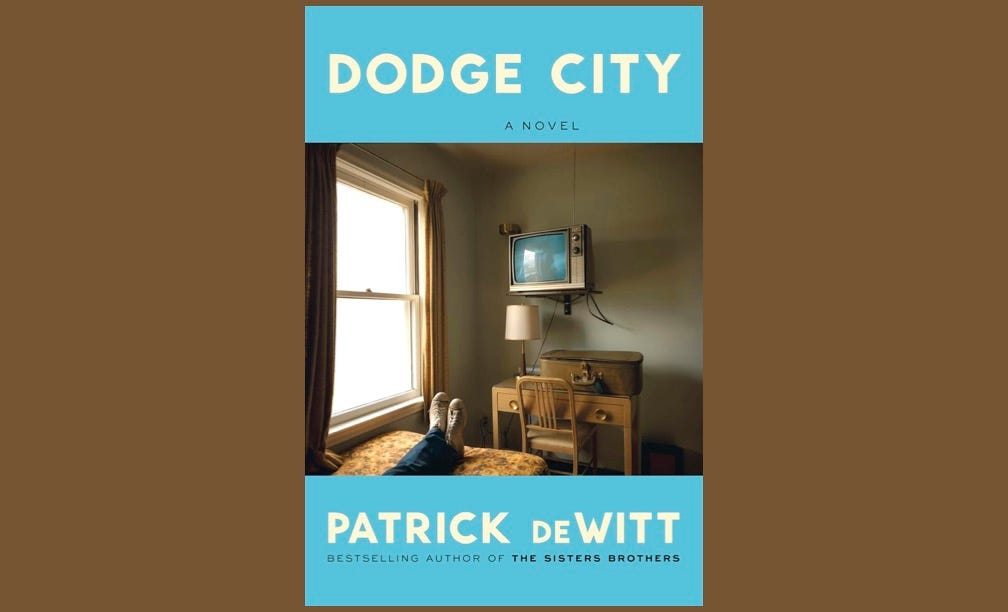
Dodge City might sound like a throwback to Patrick deWitt’s celebrated western, The Sisters Brothers, but that’s only the first feint in his wry new novel. Like that gunslinging story about fraternal assassins, Dodge City offers another deadpan picaresque of America, though this “Dodge” has nothing to do with the Wild West, and our hero wants nothing to do with guns.
The year is 1967. The Age of Aquarius is blooming, which UCLA student Lee Clarke has tentatively acknowledged by letting his hair grow one extra inch. A land-management major from Concrete, Wash., Lee likes the sound of “a new stripe of freedom” — he particularly likes sleeping with his liberated girlfriend — but the unhygienic appearance of some of these cool cats is annoying. “Lee, having grown up in a working-class household, was prohygiene,” deWitt writes. “That a grown man would expose his feet in a public setting went against Lee’s sense of propriety.”
He might have kept these opinions as buttoned-up as his Arrow shirts if he hadn’t been needled by a particularly irritating hippie at a party. Later, seeing this drugged-out jerk on the street, Lee calmly walks over and punches him in the face.
DeWitt is only 51, but he has a clear sense of how risky it was for a healthy young man to get expelled from college in 1967 when the Vietnam War was raging. Indeed, just a few weeks after the dean sends Lee packing, he loses his deferment status and receives a notice from the draft board: “Greeting.”
“The absence of an s set the letter’s tone,” deWitt writes, “which was intended to resound in the mind’s ear as the voice of a truth one could not ever get away from: artless, spare, with no trace of comradeship.”
With his small-town background and his square appearance “as a model of 1950s masculinity,” Lee makes a surprising draft dodger — surprising, that is, if you’re unfamiliar with the strangely dispassionate figures of deWitt’s uncanny universe. Lee expresses no political opposition to the war, chants no insults about LBJ, harbors no sympathy for the Vietnamese. He simply does not wish to fight and possibly die in a Southeast Asian jungle. He sees no reason his own life should be stripped of agency and placed in service to the state’s designs. His is a libertarian position drained of dogma or rhetoric.
I asked Patrick deWitt, “What interested you about creating a draft dodger whose resistance is personal rather than political?”
Determined to flee to Canada, Lee swears he’s not experiencing an existential crisis — just the first of several lies here — and signs up to drive a brand-new Jaguar from Los Angeles to New Jersey. The trip, which he has every intention of extending to the northern border, will allow him to visit family members along the way as he drives for days at a time on a baggie of speed pills.
So there you have it: Go East, young man.
Lee usually proceeds with such equanimity that you might glance at your phone for a moment and miss deWitt mentioning that “every single thing that could be spoiled was spoiled.” Such is the stealthy nature of this novel’s quiet despair.
Despite its distinctly American setting, Dodge City has been longlisted for Canada’s Giller Prize, which pleases me because I feel irrationally protective of this sweet book. DeWitt is one of very few novelists whose words I would recognize in the dark (though that would be creepy). From the start, he’s honed a tone of formal restraint that’s oddly poignant and comic. Which I think is what makes the picaresque such a successful form for him. It provides an episodic structure in which an observant but unflappable figure can move, at a certain remove, through an increasingly bizarre and damaged world.
As much as Lee is in crisis, his situation is not nearly as dire as the lives of his father, who’s working as a dogcatcher; his impoverished brother, whom he despises; or his twin sister, who’s destroying her career for love — or lust. Those encounters constitute the meat of the novel, so I won’t say much about them here, except that in varying degrees, each drop-in gives Lee the opportunity to comfort, pity, or confront these relatives who are dodging their own reckonings. As is sometimes the case, in life and fiction, their needs are too great for him to do much more than listen — and leave.
But those conversations are the heart of deWitt’s genius. As his fans know, he’s perfected a style of clipped dialogue that’s half Bertolt Brecht, half Bob Newhart.
Here’s Lee talking to his mother on the phone:
“Is it true that you’re coming to see us?”
“It’s true.”
“How long will you stay?”
“Not very long.”
“One hour?”
“Overnight.”
“What size party would you like?”
“I don’t want any size party.”
“Possibly a small party, or very small?”
“No party, Mom.”
“Well how shall we mark the occasion?”
“The occasion will mark the occasion.”
“You sound like a crazy fortune cookie.”
“I don’t feel like one.”
The eye practically falls down the page while the ear tries to keep up with these shifting tones of pique and amusement.
But this isn’t just scriptwriting à la Gilmore Girls. DeWitt is also continually holding us at arm’s length with that tincture of artificiality. When Lee visits his hometown, for instance, his father asks him, “What is the function of your mission?”
Later, his uncle asks him, “Are you feeling waves of great bitterness at the lunatic machinery of mankind pulling you into its grim mechanisms in opposition to your wishes and against the commonsense morals of mother nature?”
Hear that — that weirdly formal tone? They sound like Civil War soldiers in a Ken Burns documentary. You’d be tempted to think it’s a peculiar characteristic of these two men, but it’s actually a peculiar characteristic of this novelist’s voice, which bends each of his characters toward what deWitt calls “the oddments of the story.”
Who uses the word “oddments”? It’s odd squared.
If this were all just some hip affectation, it’d be unbearable, but deWitt is using this style to capture the soiled grandeur of our lives. Funny as it is, there’s something ennobling about his highfalutin language, which manages to mock and sanctify “the immeasurable folly of the species.”◆
Dodge City, by Patrick deWitt (Ecco, 256 pp., $28).
Previous review: The True Confessions of First Lady Freeman, by Deesha Philyaw
A wealthy pastor’s wife with secrets, ambition, and a wicked wit tells all in Deesha Philyaw’s smart, saucy first novel.
“The lunatic machinery of mankind” and “the immeasurable folly of the species” are phrases that parallel Puck’s observation, “What fools these mortals be.” You selected 2 phrases from Dodge City that echo my despair of the inanity of human behavior. While Shakespeare’s Puck was amused, Dewitt agonizes. Your choice of books to review and your comments are so important to readers. Thank you for continuing to review worthwhile books.
A trivial reaction to be sure, but I couldn't help laughing out loud at the start of this review. My mother schooled me specifically: "One should not show one's toes in public more than twice a week even in summer."