
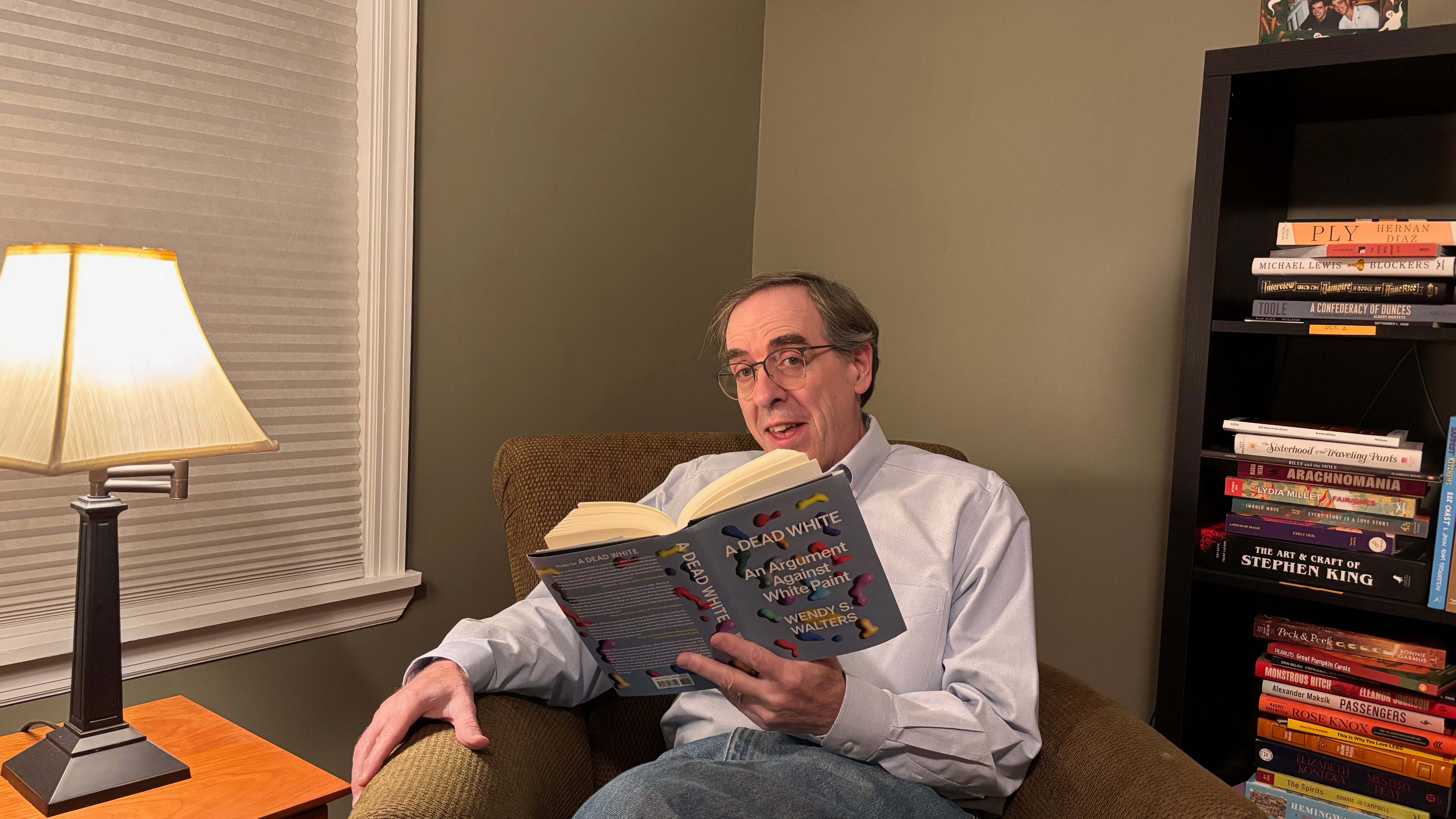
Working from home for good (or evil) forced me to get serious about a home office. For decades, I’d been toiling away in a finished section of our basement, insisting to myself that the mold smell was just in my mind and that all those spider crickets were more cricket than spider.
Taking over our younger daughter’s long-vacant bedroom, which had devolved into a teen version of Miss Havisham’s parlor, seemed like the obvious choice to establish my new career as someone freed from the encumbrances of a paycheck. But even after emptying it out (mostly) and lugging my desk up two flights of stairs, I was left staring at the room’s brilliant orange walls, an aesthetic abomination we had allowed our daughter as a consolation for moving to D.C. and ruining her life “forever.”
At The Washington Post, my office, like everyone’s office, had been painted institutional white, and I imagined that I wanted something similarly “professional” at home. But around this time, I received an advance copy of a curious book titled A Dead White: An Argument Against White Paint, by African American writer Wendy S. Walters.
The first two times I started A Dead White, I bounced off it like a moth against a lit window, but when it was longlisted for a National Book Award — a month before it was published — I bore in.
Walters’s years-long hatred of white paint began one morning as she dropped off her son at school and felt suddenly unnerved by white’s ubiquity. “It has become a kind of standard backdrop for the action of our lives,” she writes, while acknowledging that her fixation initially struck her as absurd.
“I had not noticed white paint to be an opponent to my life or the lives of others. But after that day, its small, daily affronts provoked a new awareness and degree of alarm.”
“I started to suspect that white paint — a commonplace, ordinary material — carried some symbolic importance that had not been named.”
This book, then, is her effort to name what white paint means, what it conveys, and what it covers up.
It’s a gloriously, at times maddeningly discursive book — some three dozen short chapters that move freely from memoir to art history to cultural analysis, loosely arranged around the experience of having her New York apartment painted. At times, it feels as though Walters selected the entire world and typed Command-F “white.”
Early on, she claims, “This is a book about white paint, not about whiteness.” But that’s like claiming Moby-Dick is about whales, not about obsession.
It had never occurred to me to wonder when people started painting their walls white — the pigment seems so normal, so neutral — but Walters takes us back to the 1860s when British architect-designer Edward William Godwin boldly painted white over the wallpaper on his ceiling. Years later, Oscar Wilde hired Godwin to decorate his London home, where he created a white dining room.
Soon, other designers were praising the egalitarian qualities of white paint. “There was elegance in the white room’s plainness,” Walters writes, “and it could be embraced by everyone without drawing attention to stark lines of class.”
But how quickly white paint, often made with lead, became associated with virtue and racial purity. Walters tracks down an advertisement from 1910 that links the attractiveness of white paint to the benefits of being “a white-leader and all that goes with it.” Fun pun or racist nudge?
Ranging across time and around the globe, Walters notes that prison cells in Guantanamo and torture chambers in Iran are painted white as a practice of sensory deprivation “to prevent an individual from finding comfort in the physical aspects of the world.”
She writes movingly about acts of vandalism, defacement, and even murder carried out with white paint.
And there’s a fascinating section that begins with her early work as a mime in whiteface and moves into a consideration of women’s makeup during the Renaissance.
Whether exploring Frank Lloyd Wright’s hatred of white paint or the design of the White House, Walters is not exhaustive; she’s suggestive. Insist that she explain exactly what white paint signifies or what color you should paint your home office, and you’ll leave frustrated. But if you allow this book to teach you how to read it, you’ll find here an illuminating exercise in seeing beneath the bright, bland surfaces of our lives.
Walters’s “Argument Against White Paint” doesn’t dry with the shiny surface of a hard thesis. It stays wet. It’s ultimately a series of fluid reflections on what it means to become aware of the hues of a world streaked by racism and convulsed by violence.
Halfway through, I began to imagine how effective A Dead White might be as a performance piece. Caught in the verbal spell of an electric actress, we’d run along this path of melodrama, historical excavation, and revelation without that pesky insistence on analytical coherence that the printed page encourages.
“I was painting the apartment to improve my confidence,” Walters writes. “I wanted to draw a line between the past and the present.”
Me too. For my office I chose Behr’s “Muted Sage.” I love it, and now I also have a vivid sense of what I avoided.◆
The rest of the newsletter follows below:
Books Go to the Movies
Sense and Sensibility, starring Daisy Edgar-Jones and Esmé Creed-Miles, opens today in theaters. It’s hard to imagine anyone competing with Emma Thompson’s 1995 adaptation of Jane Austen’s classic, but perhaps I have suffered the punishment of an attachment, without enjoying its advantages.
The second season of Maigret, starring Benjamin Wainwright, begins Sunday on PBS. The series, set in contemporary Paris, is inspired by more than 70 novels about Chief Inspector Jules Maigret that Georges Simenon published from 1931 to 1972.
An opera based on George Saunders’s Lincoln in the Bardo opens at the Met in New York on Oct. 19. Missy Mazzoli composed the music; Royce Vavrek wrote the libretto. Saunders’s spectacular debut novel, which won the 2017 Booker Prize, is a ghostly tale of the wild spirits and mournful souls who lurk in the cemetery the night Abe and Mary Lincoln’s 11-year-old son is laid to rest. Through Nov. 14 (tickets).◆
The Whiteness of the Whale
In the summer of 1983, when I visited Herman Melville’s house in Pittsfield, Mass., I picked a gourd from the vines growing behind the barn.
Like any Melville fanatic, I cherished that gourd for decades until it became a desiccated skull of rattling seeds and eventually disintegrated.
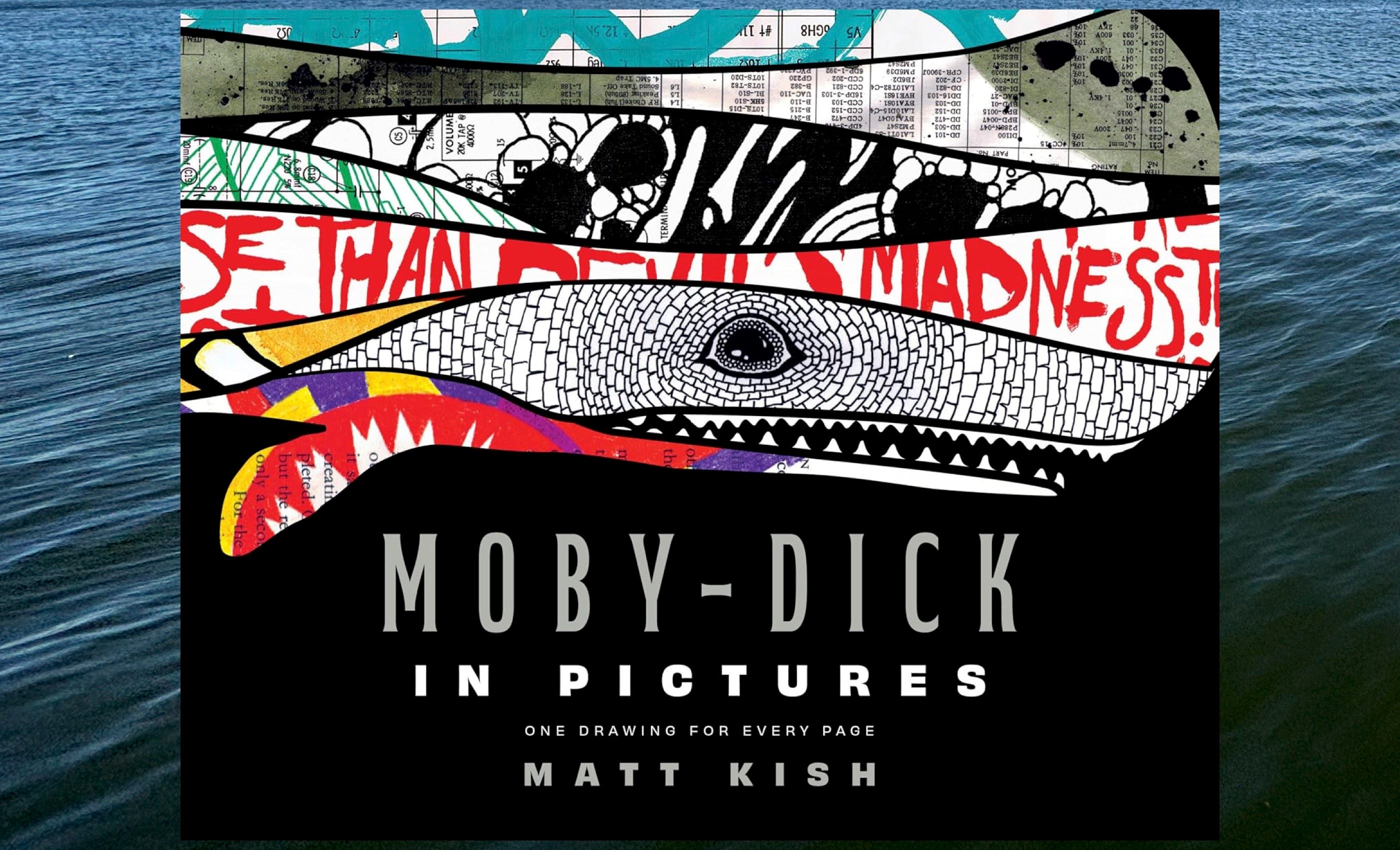
If you are or know such a fanatic, you might hunt down a copy of Matt Kish’s Moby-Dick in Pictures. This splashy volume, newly republished to commemorate the 175th anniversary of Melville’s classic, contains a full-page illustration and a brief quotation for every page of Moby-Dick.
The images, using everything from ballpoint pen to crayon to acrylic and stickers, sail across an endless variety of tones and styles, though they’re clearly influenced by 1970s albums and sci-fi covers. It’s a work of awesome, even terrifying fixation.
“I began to identify more and more with Ahab,” Kish writes in the introduction, “obsessed with the idea of the White Whale and the task of finally finishing the art and slaying the monster. I worked harder and harder each day. I lost sleep. I drew in the car while my wife drove us home from work. I ate my meals in minutes and rushed back to the closet studio to keep drawing and painting. It was all I could think about, and it started to devour every waking moment.”
If the moment has finally come to harpoon this giant classic, you might enjoy Exploring Moby-Dick, a new podcast series hosted by the actor Rob Delaney (Catastrophe) and Hester Blum, an English professor at Washington University, where I abandoned my Ph.D. in 19th-century American lit about the time I was nipping Melville’s vegetables. With a wild mix of enthusiasm, wit, and scholarship, Delaney and Blum make congenial shipmates on this long voyage. The series contains 21 episodes, released weekly, for $59.99 (details).
If you’ve read Moby-Dick, you’ll enjoy a recent essay by Michael C. Kimmage in the journal Liberties about how Starbuck is a model for the American citizen (read).
And finally, even people who wouldn’t know a white whale if it bit their leg off are getting obsessed with a bronze statue of Melville unveiled this summer in New Bedford, Mass.
“This statue of Herman Melville is hot,” says Meredith Goldstein, the Love Letters columnist at the Boston Globe. Sculptor Stefanie Rocknak “made him seem like the kind of guy who, in my opinion, could stare into your soul and then kiss you until you forget your own name.”
Call me Ishmael.◆
Underlined
A periodic feature highlighting a passage from something I’m reading.
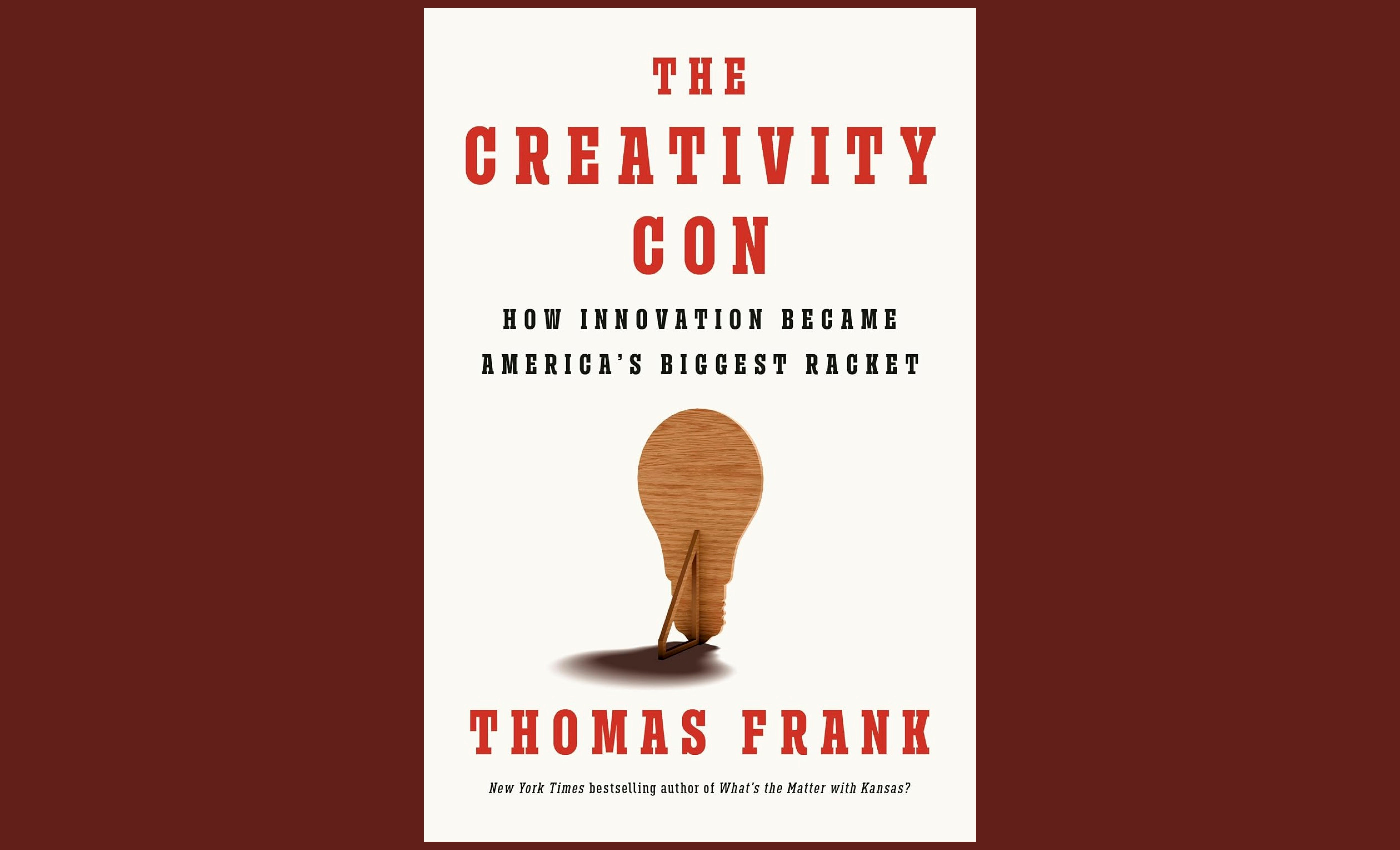
What if innovators aren’t interested in the Innovation Agenda? What if they don’t want to help America “win the future”? What if they just want to make themselves rich? ... Once you start thinking about abusive innovation, examples readily come to mind. Firms innovate constantly to get around regulations. They dream up ways to fatten the compensation packages of their top officers — innovation in looting, you might say. There are innovations in wage theft, in junk fees, and in methods for deceiving customers. The amount of high-IQ brilliance that has gone into preventing farmers from repairing their own machinery would probably be enough to power several Manhattan Projects.
From “The Creativity Con: How Innovation Became America’s Biggest Racket,” by Thomas Frank (Penguin Press, forthcoming Oct. 20).◆
Picture This
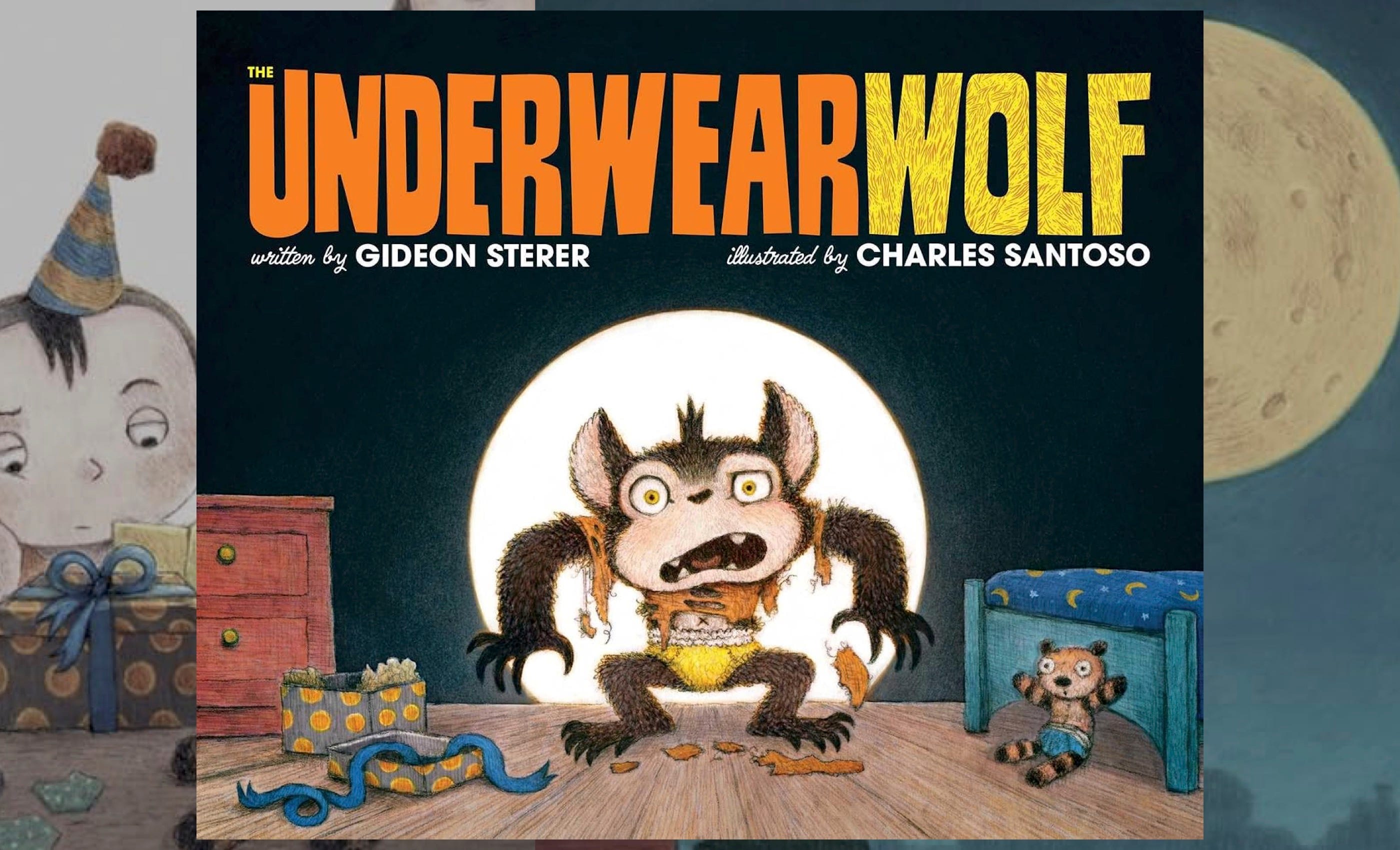
The Underwearwolf is one of those picture books my younger brother and I would have howled over when we were kids (and still).
Gideon Sterer’s hairlarious story describes the travails of a little boy who receives a pair of underwear with a stern warning never to wear them during a full moon.
Of course, that night is a full moon, and he tries them on.
Soon, he’s transformed into the monstrous Underwearwolf and charges out into the night grunting and growling.
“I leapt across rooftops. I bit a bird feeder in half,” he says. “I really should take off the underwear, but then I would have been butt naked on top of a chimney!”
The risk of embarrassment and the pull of the moon are too much. And now he’s leading a pack of hungry wolves.
“Nothing could stop me, not even a wedgie, right up my big furry butt.”
Readers will eventually get mooned, too, by Charles Santoso’s loony illustrations, which provide just the right wild energy to Sterer’s brief tale.
By the end, of course, our frazzled hero pledges never to wear those undies again ... “until the next full moon.”
Presumably The Underwearwolf has already been banned in Texas, but if you know any kids ages 4 to 8, sneak them a copy. They’re bound to say, “Fangs a lot!”
P.S. Nothing will sweep you into the Halloween spirit faster than singing Peanuts Great Pumpkin Carols. These spooky ditties — written by Daniel Kibblesmith and set to classic Christmas tunes — range from “Linus the True Believer” to “O Hide, All Ye Fearful.” Delightfully illustrated with Charles Schulz’s Peanuts characters, this is a book to gather the ghouls every October.◆

This Week’s Poem
The poems in Erin Belieu’s new and selected collection, Cocklebur, live up to that modest botanical title. You may not ever notice how these verses attach themselves to you with their little barbs, but they will hang on — and needle you.
This book draws on five previous collections, going all the way back to 1995, and nine new poems, including this one:
Late Autumnal, with Cockroach
Morning thick with inscrutable dinge;
another season drained. I’m watching
the pest control man fill the rat bait
station, black attaché of poison hidden
in the hedge.
And while I pay a monthly bill
for him to do my killing, still
it seems miraculous, how much insists
on surviving, despite us. What grinds it out.
What hustles simply to continue.
Like this plumply enormous
roach, its carapace the molten brown of
topaz, tooled cannily to fold into a ceaseless
package: look at it now collapsing to fit exactly
between my deck’s wooden slats.
No matter what unspeakable
agents we devise for it to carry to its nest,
there comes a calm in knowing there will always
be an awful, inexorable more of something,
other than us, to crawl or slither, gnaw & be
gnawed; a peaceful certainty of moreness,
creeping through our filth to greet what’s
coming soon.
Unloved, ingenious creatures,
the few truly diligent, whom we can never
drive off or annihilate completely, this poem
remembers you, waiting in our unplugged
cracks & fuming sewers, seeing
the relentless engines you’ve willed
yourselves to be;
      the valor of your tidy
      and despised machinery.
“Late Autumnal, with Cockroach” from “Cocklebur: New and Selected Poems.” Copyright © 2026 by Erin Belieu. Used by permission of Copper Canyon Press.
P.S. At the 25th annual Zora/Legacy Award ceremony, Douglas Kearney won the Poetry prize for I Imagine I Been Science Fiction Always. Last year at the Library of Congress, I spoke with Kearney about this collection, which includes some of his “performative typography.” I guarantee you’ve never heard poetry like this (watch).◆

The Great Pumpkin
Dawn and I spent most of this week in California with our elder daughter, Elissa.
Despite the holiday’s scent of brimstone, in our family, we’ve always considered Halloween more Hershey’s than heresy.
On Tuesday, we all painted pumpkins in a style haunted by Jackson Pollock.
It was, I can assure you, the most sincere pumpkin patch in the world.◆
Clippings
This week’s review is of Yiyun Li’s Music Against the Night, which resurrects a once-famous Irish musician and his fiercely ambitious wife (review).
To Hear Her Speak opens today at the Folger Shakespeare Library in Washington. Drawing on the work of Phillis Wheatley, Ida B. Wells, Maya Angelou, Lorraine Hansberry, Toni Morrison and Adjoa Andoh, this new exhibit explores “how Black women have engaged Shakespeare both on and off the stage through the centuries.” Through May 2, 2027 (details).
Last week, I offered a copy of The Art & Craft of Stephen King: The Story Behind Every Novel, Novella, and Short Story, by Guy Astic and Frank Lafond, to the 13th reader who told me, “They’re all gonna laugh at you!” London, a middle school reading specialist in the Chicago area, is the cursed winner. “My first experience with King was on a beach in South Carolina, reading Pet Sematary,” she tells me. “I couldn’t believe how terrified I was in the warm sun in the middle of the day!” She recently enjoyed King’s collection You Like It Darker, whose opening story refers to a book critic named ... Ron Charles.◆
This newsletter may be the only subscription on Substack that I read start to finish every single issue. Always surprising tidbits in it.
I would have choked if I had been drinking my coffee when I read “Presumably The Underwearwolf has already been banned in Texas, ….”, living in Texas I know you are surely correct in your observation. I laughed so hard at that great observation. I and my wife very much enjoy your reviews. Thanks for what you do.