Will Human-Raised Children Become a Luxury Product?
AI is a seductive substitute for the relationships that teach us empathy, curiosity, and resilience.

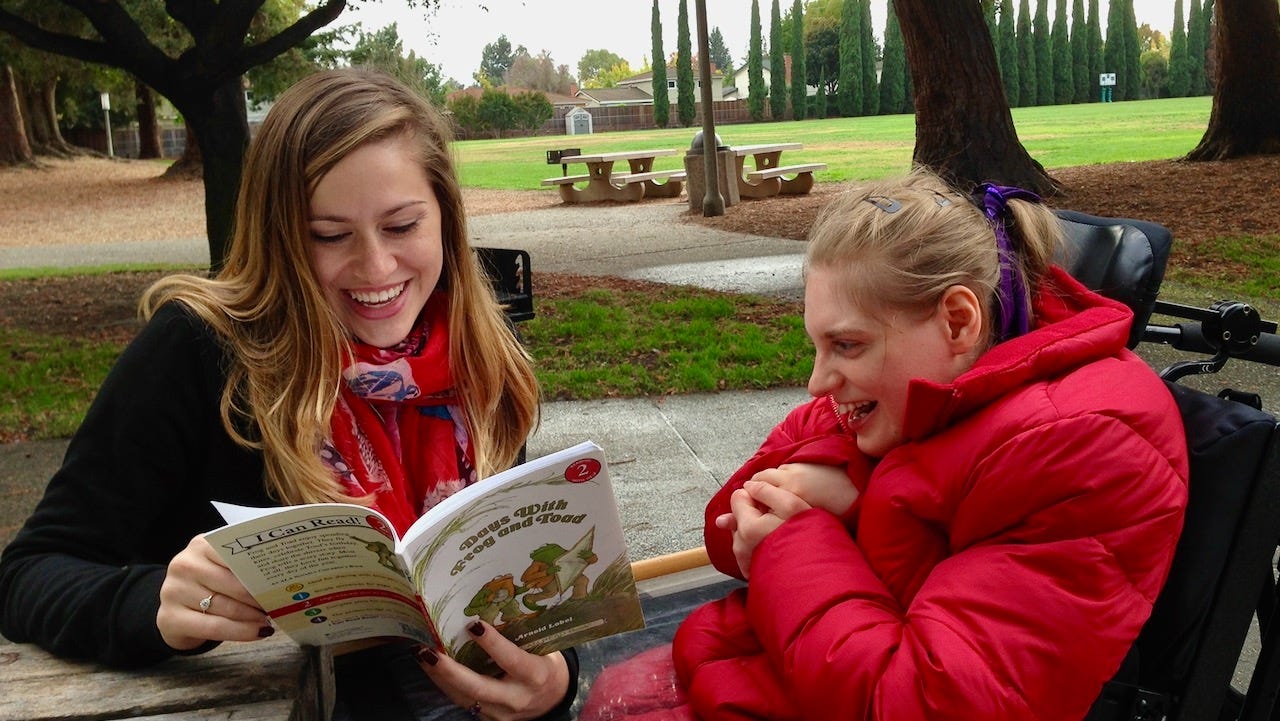
Dr. Dana Suskind remembers when her waiting room crackled with children laughing and crying. “Now,” she says, “I go into the clinic, and it’s eerily silent.”
Not empty, mind you, just silent. “Everyone from the parent to the grandparent to the older sibling to the child is scrolling on their screens.”
Suskind gave the keynote address at the recent “Literacy for Democracy” conference in Warsaw (video). A pediatric surgeon who specializes in cochlear implants, she’s sharply attuned to the way communication enhances brain development.
She’s long been concerned about the way phones and tablets suck up children’s attention. But now she’s even more alarmed by what’s lurking on those screens: a seductive simulation of companionship generated by AI.
“We have perfected the art of artificial connection,” she says, “at the exact moment when we seem to be neglecting the critically important biologic necessity for human connection and those human capacities that are so necessary for democracy.”
Those capacities, she warns, are not innate. They’re built through human communication, reading, and real-life experiences that teach us how to live with one another.
Suskind notes that “learning to be human is friction-filled” — and should be. But those little irritants, delays, compromises, and negotiations are the very things that AI is designed to eliminate. So imagine a generation of children reared in a soothing vat of chatbot affirmation and sycophancy. “That’s not going to allow us to raise humans that are part of a civil society,” she says.
AI chatbots are not just building engagement; they’re building intimacy. And that creepy maneuver robs children of the chance to develop self-regulation, resiliency, creativity, empathy, critical thinking, and curiosity — “skills built by human connection, by reading between an adult and child.”
In a preview of her upcoming book, Human Raised: Nurturing Connection, Curiosity & Lifelong Learning in the Age of AI, Suskind contemplated the horrifying prospect that a child nurtured by human beings might soon be something rare and expensive, like organically grown strawberries.
Everyone else can munch on Doritos.
The window of opportunity for meaningful regulation is closing fast. “The choices we make now,” Suskind says, “will help determine whether ‘human-raised’ becomes a luxury label or remains a universal birthright.”
The algorithms are already in the bedroom, lulling our children into lonely slumber.◆
The rest of the newsletter follows below.
Books Go to the Movies
The Wizard of the Kremlin, starring Jude Law as Vladimir Putin and Paul Dano as his Machiavellian adviser, is playing in theaters. The political drama, directed by Olivier Assayas, is based on Giuliano da Empoli’s 2022 novel, which won the Grand prix du roman de l’Académie française.
W.E.B. Du Bois: Rebel with a Cause premieres on PBS on May 19 (trailer). The documentary, narrated by Viola Davis, explores the life and work of the pioneering Black scholar and civil rights activist, with commentary from Henry Louis Gates Jr., Eddie Glaude Jr., Nikole Hannah-Jones, Imani Perry, and others.
Penguin Young Readers has launched a new YouTube channel based on its Who HQ nonfiction books for middle-grade readers. Like the books — 70 million copies in print! — these short weekly videos tell “stories of trailblazers, legends, champions, innovators, world-famous places, and important events throughout history.” The first episode focuses on Alexander Hamilton (video). It’s jaunty without descending into zaniness, which, considering the competition, is admirable but risky.◆
Certified Human
One of the strangest little businesses developing in the age of artificial intelligence is a company that certifies books and articles as genuinely written by humans.
No, really.
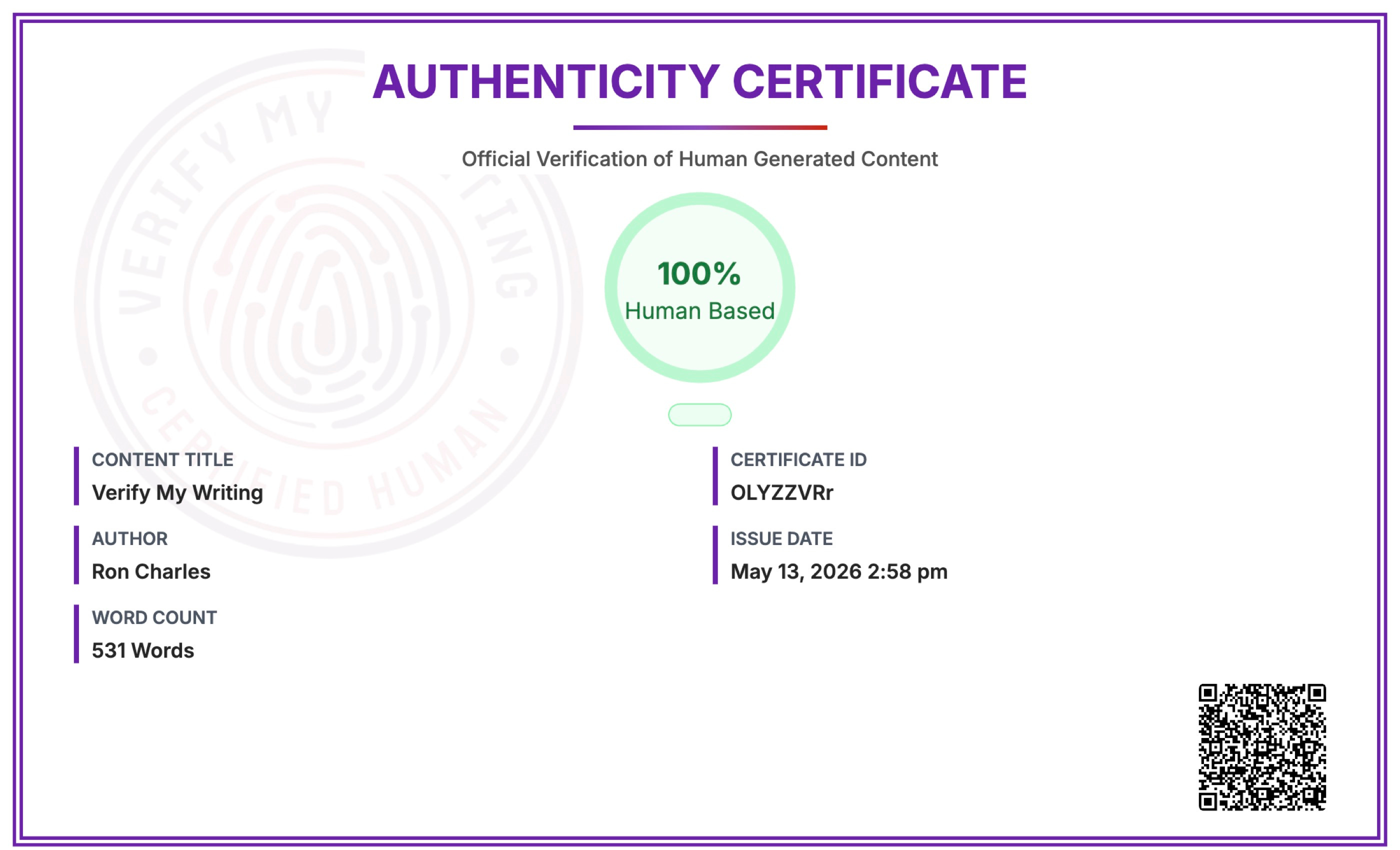
This week, I talked with Derek Newton, a Washington-area journalist who has launched a service called Verify My Writing. For a fee — generally $10 for a magazine article or about $65 for a novel — writers can submit their work to be scanned by AI-detection software. If the system concludes the text is at least 95 percent human-generated, the author gets a certificate and a badge that can be printed in the book or attached to a manuscript submission.
Newton compares it to labels on coffee and olive oil: certified organic, fair trade, authentic Italian.
“We have hundreds of marks and laws about what we put in our bodies,” he told me, “but not a single mark about what we’re about to put in our heads.”
If this all sounds slightly absurd, well, yes. But it’s also oddly compelling.
I’ve already started seeing little “human-created” seals popping up on some books, mostly from Britain. The Authors Guild has introduced one, too, although that’s essentially an honor system: Authors simply affirm that they wrote the work themselves. Newton thinks independent verification is necessary because people using AI obviously have an incentive to conceal it.
The larger question is whether any of this actually works.
For years now, we’ve heard that AI-generated prose has become impossible to detect. But Newton argues that the opposite may be happening. He claims the biggest language models are becoming increasingly predictable because they’ve absorbed such enormous quantities of text that they now gravitate toward what he called “the happy average.”
“It is impossible to search the billions of records they have quickly enough,” he said, “so what they’re learning on their own is how to serve average requests with average material more quickly.”
In his telling, AI prose is becoming easier to spot, not harder.
Now, many experts remain skeptical of AI-detection systems, which can produce false positives and false negatives. Universities that rushed to adopt AI scanners have already faced embarrassing cases of students wrongly accused of cheating.
Still, what interested me most wasn’t the technical argument. It was the emotional one.
Newton believes readers increasingly want reassurance that another human being actually suffered to produce the thing they’re holding.
“I want credit for that,” he told me. “I want people to know I did the work, that I agonized over the edits.”
At an art fair in Bethesda recently, he noticed several photographers displaying signs that read: “Not AI. Actual photographs.”
There it is: the emerging premium on authentic human labor.
Whether these certification systems become standard practice or disappear like New Coke remains to be seen. But it’s fascinating to watch entirely new industries spring up around our uncertainty over what’s real, what’s synthetic and whether we’ll continue to care about the distinction.
Personally, I suspect many readers still do. Competence has never been the highest virtue in literature. Readers want the pressure of another consciousness — the weirdness, obsession and emotional risk that emerge when one person struggles to say something true to another.
P.S. The entire item you’ve just read was written by AI. To create it, I submitted a transcript of my phone interview with Derek Newton to ChatGPT and told it to generate a 500-word story in my voice. I then sent that AI slop to VerifyMyWriting.com and received an Authenticity Certificate for “100% Human Based.” The whole process — including my payment of $10 — took 90 seconds, or about the same amount of time it took for American journalism to die.◆
Literary Prizes and Honors
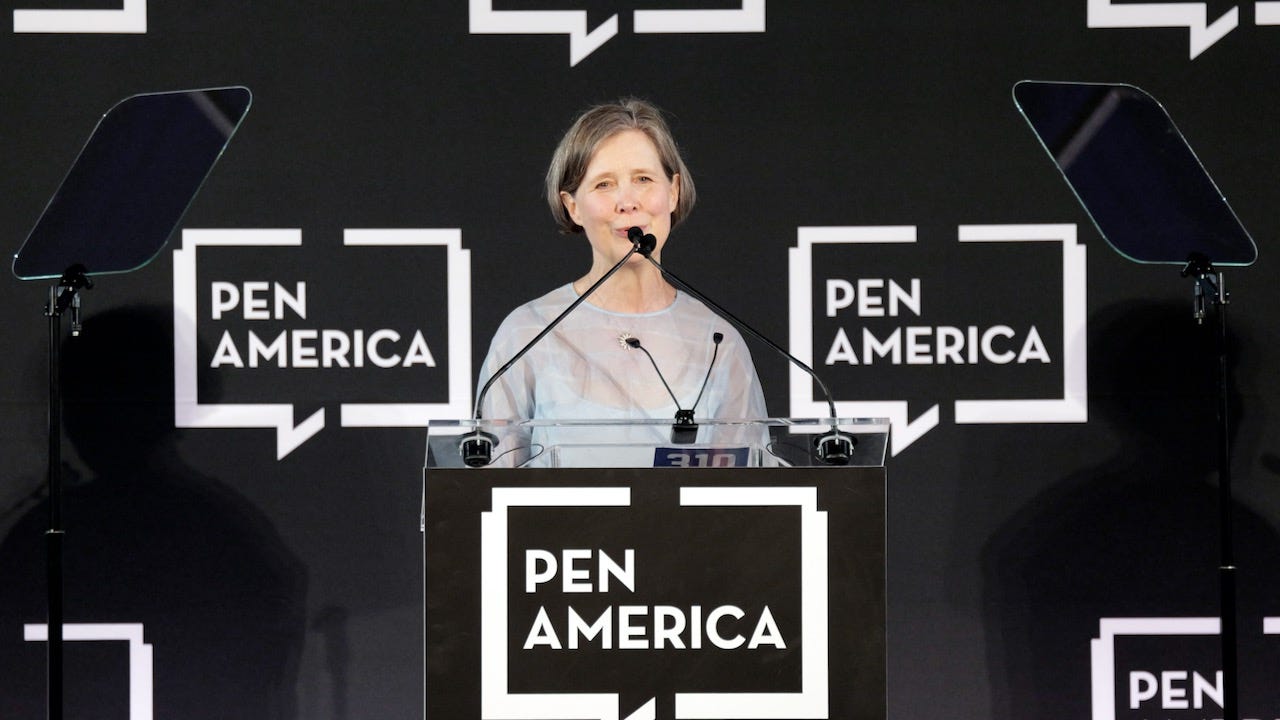
Ann Patchett received the PEN/Audible Literary Service Award at PEN America’s literary gala hosted by B.J. Novak last night in New York. Patchett’s next novel, Whistler, will be published June 2.
I Regret Almost Everything, a memoir by restaurateur Keith McNally, won the $50,000 Gotham Book Prize, which honors a book about New York City, because that hardly ever happens.
Lee Lai’s graphic novel Cannon won the Stella Prize, an Australian award for women and nonbinary writers. The book, about a queer Chinese woman caring for her aging grandfather while working in a restaurant, is the first graphic novel to receive the prize, which is worth about $43,000. The judges said, “Cannon is an incontestable reminder that — in the hands of a masterful artist and storyteller — the very best graphic novels can do what prose alone cannot.”◆
Picture This
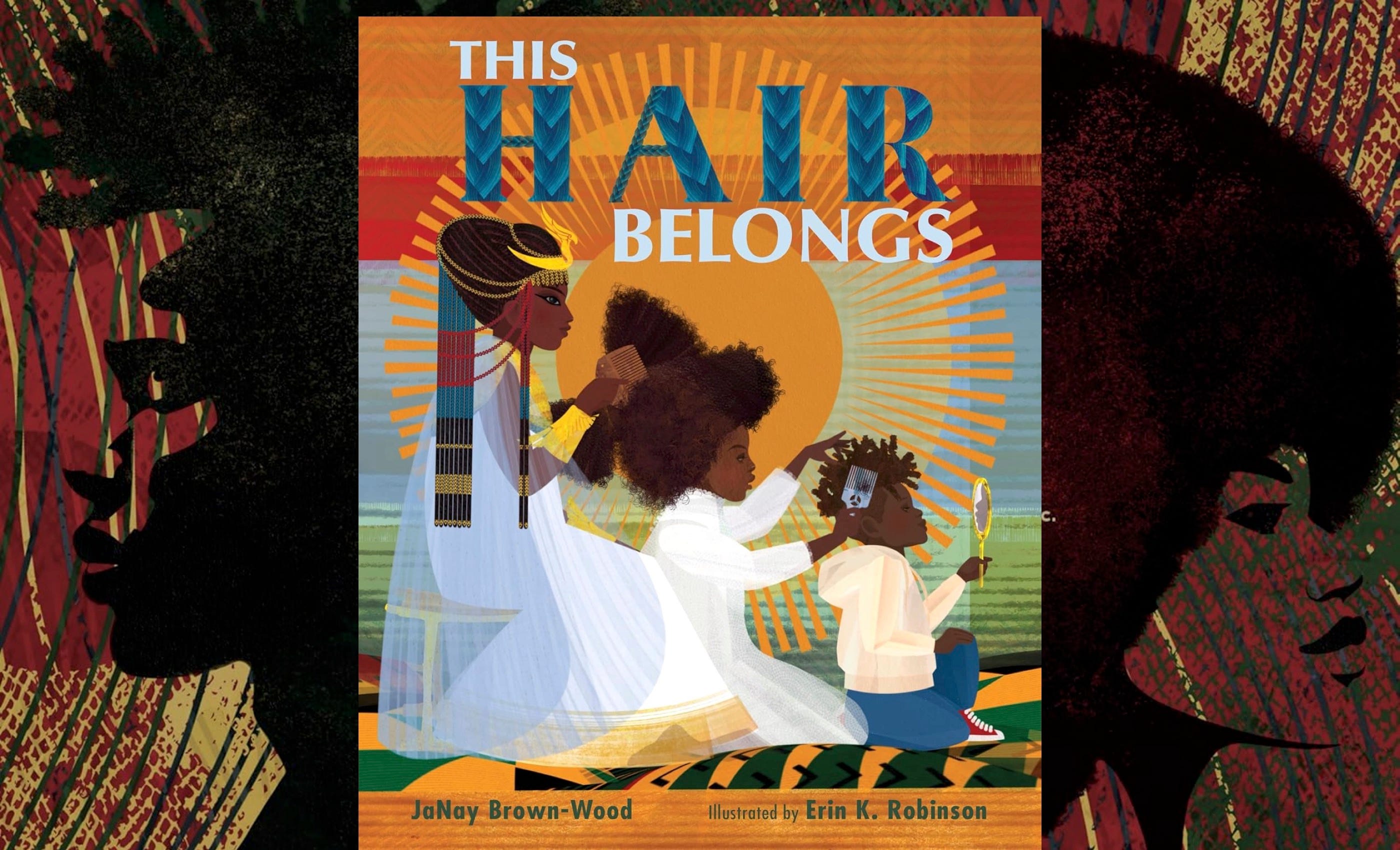
This Hair Belongs, by JaNay Brown-Wood, is a gorgeous ode to Black beauty.
The text’s exuberant joy sprang from painful childhood memories. In an author’s note, Brown-Wood explains that for years she submitted to harsh chemical relaxers. “I endured this treatment until I was an adult,” she writes, “when I finally embraced my natural hair.”
With this book, she celebrates not just how her hair “curls in perfect spirals” but the long history and cultural significance of Black hair — reaching all the way back to kings and queens in Africa.
This hair
curls
like the corkscrew albuca;
it spans
generations long like the church in Ethiopia
and the pyramids in Egypt.
Her incantatory lines sweep through millennia, acknowledging periods of oppression:
When our hair was shaved
and ridiculed
and likened to the wool of uncouth beasts —
we lost our way.
But hair like this will not be tamed.
Erin K. Robinson’s dazzling illustrations vibrate somewhere between collage and stained glass, creating an unusually powerful harmony of text and image.
A glossary at the back offers parents and teachers additional historical context about hair traditions.
Although this book speaks especially to Black children, readers of all backgrounds will be inspired by its musicality and radiance.◆
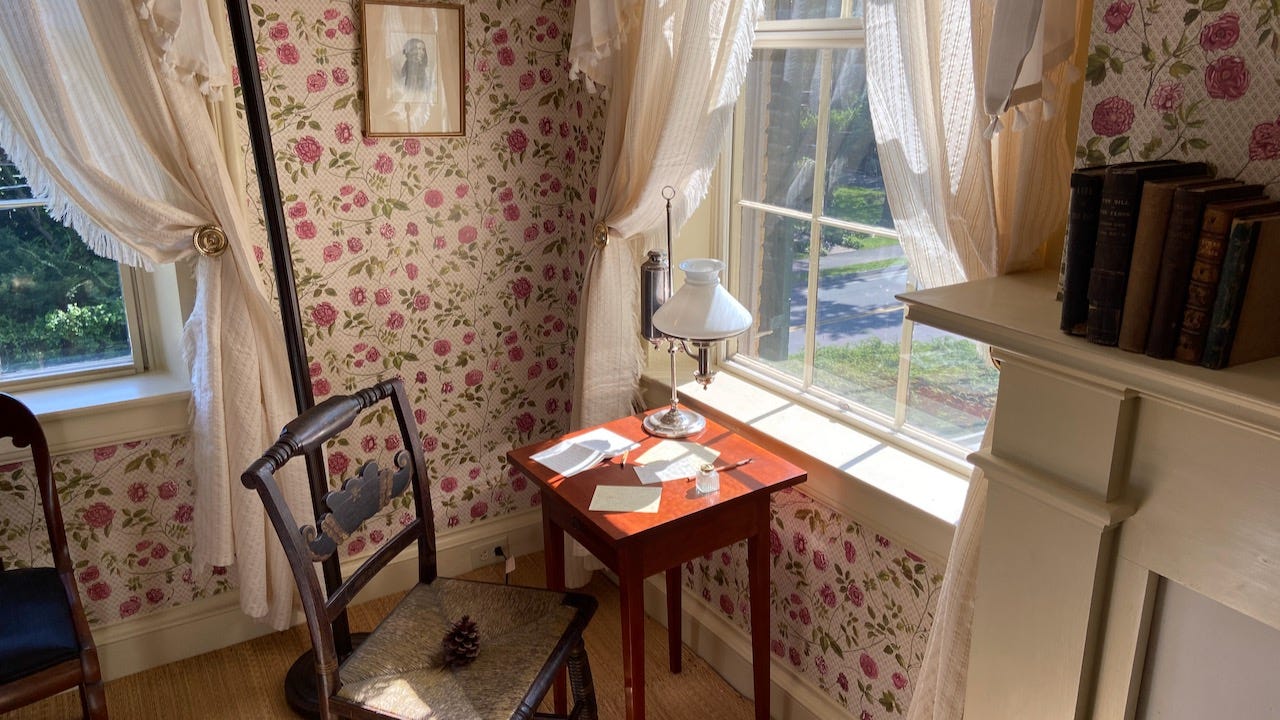
I Heard a Fly Buzz
Today marks the 140th anniversary of Emily Dickinson’s death.
When Dickinson was “called back” in 1886, she was virtually unknown and, except for a handful of anonymous pieces, unpublished. But the nearly 1,800 poems she left behind in hand-stitched booklets eventually found readers around the world and transformed American poetry.
Tomorrow morning at her home in Amherst, devotees will meet to begin their annual Poetry Walk through town to the West Cemetery, where they’ll lay daisies on her grave. All are welcome to join in (details).
For me, this observance is tied to memories of my friend Ellie Heginbotham, a Dickinson scholar in D.C. who passed away a few months ago. Her specialty was the study of those stitched booklets, called fascicles, which Ellie saw as a kind of carefully edited publication.
In 2024 — after years of planning — Dawn and I got tickets to see the Dickinson house for the first time. But we arrived on the wrong weekend, right in the middle of a special conference closed to the public.
Just as I was moping my way back to the car, Ellie’s voice rang out: “Ron?!” Of course she was there.
We got a special tour of the house. We stood at Dickinson’s desk, staring out the window where she realized “Forever — is composed of Nows —.”◆
This Week’s Poem
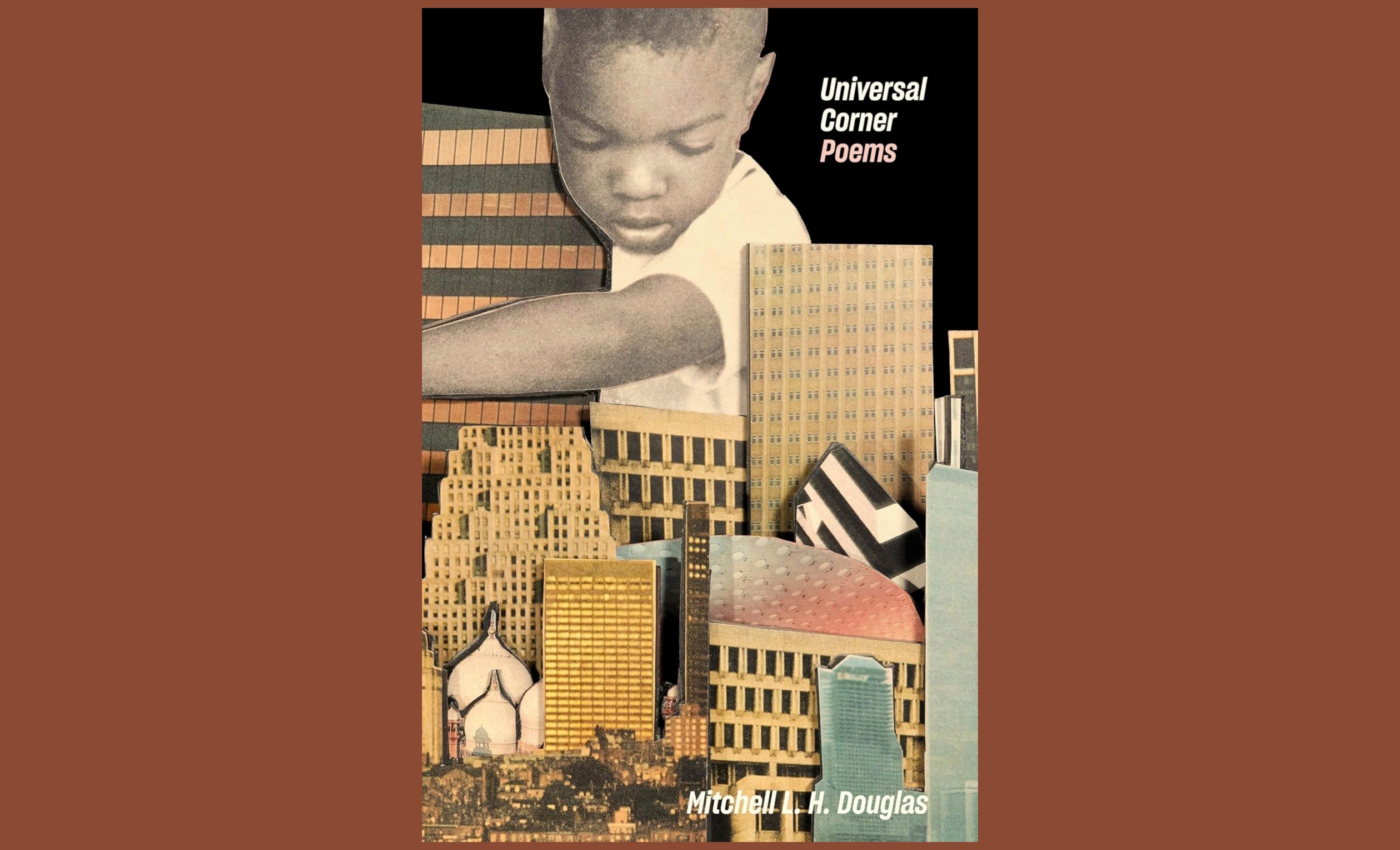
Mitchell L.H. Douglas was a visual artist before he became a poet and a lover of music even before that.
You can see and hear those influences in his latest collection, Universal Corner, which moves with a strong sense of how his lines look and sound.
This is a poet who relishes the riff, the surprising collage of cultural references, the unexpected segue.
One poem begins, “Gwendolyn Brooks was a Jeopardy question no one could answer tonight.”
In the large canon of poems about poetry, this is one of my favorites:
My Student Says, “Damn, Prof. Where Are All the Happy Poems?”
& I have to tell them the tale we all fear. There was a time when poets smiled, smoked
cigarettes @ readings, & nothing was ever touched after a first draft. Some called it
Nirvana, some Mecca. Then the drama
started. Who knew the word Mecca would unearth all those bigots (JK — we knew)?
It was a long war as wars often are. Both sides decimated in the desire to be right
when only one was. Editors trembled
(then ignored telegrams). We writhed in the pages of unwritten love poems. Book burning
became fashion. You bragged about attendance like Hoosiers @ lyn... it was a state
no one wanted, like New Jersey. Forgive me,
I couldn’t resist. I’ve never been to the Garden State, but I love the poets there —
the poeming in their slightly/sorely blood-laced dirt.     This is a cry for help, a stab
wound & the stitches meant to heal. “Enough of the telling,”
my student says, “show me everything.” Listen, I plead, sometimes, a poem doesn’t know
its own power. Sometimes, a line break
                            is the state of a heart.
Excerpted from “Universal Corner.” Copyright © 2026 by Mitchell L.H. Douglas. Published by Persea Books. Reprinted with permission of the publisher. All rights reserved.
P.S. Last night at Swansea University in Wales, American poet Sasha Debevec-McKenney won the Dylan Thomas Prize for her debut collection, Joy Is My Middle Name. The award, worth about $27,000, “celebrates exceptional literary talent aged 39 or under” (video).◆
The Writing Life
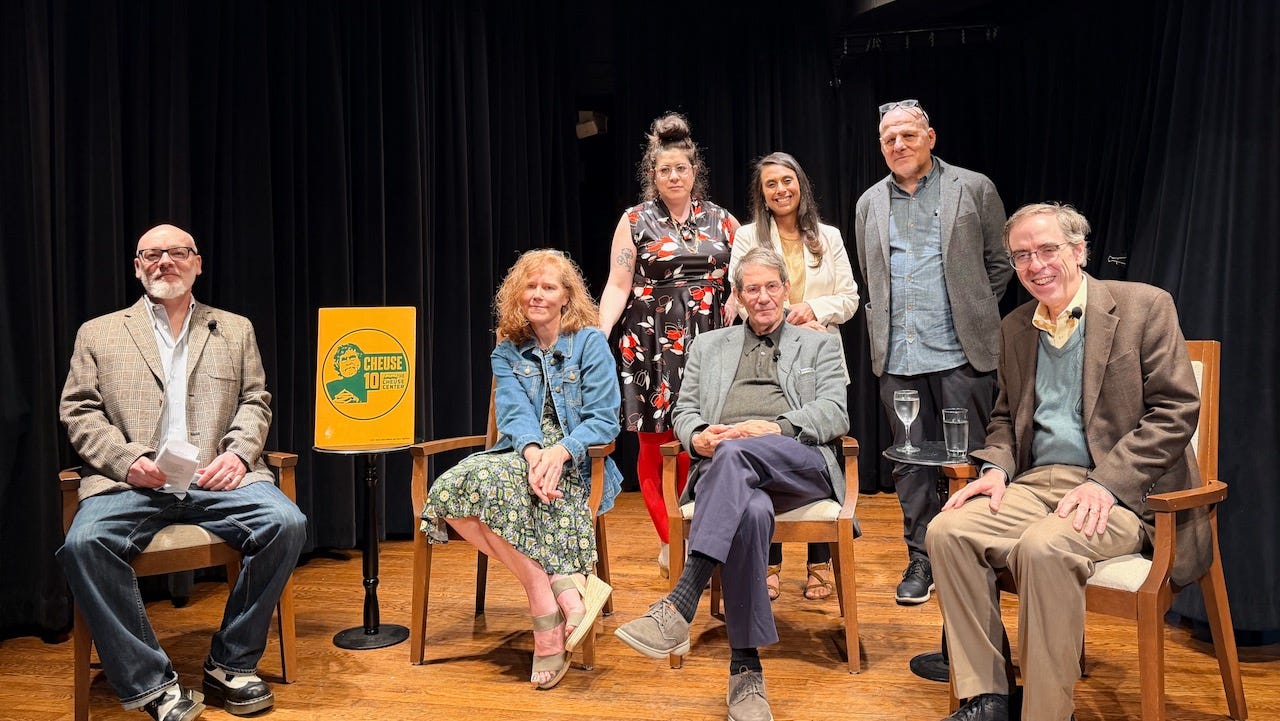
Last night, we remembered Alan Cheuse, the teacher, editor, and NPR book reviewer who died in 2015. The Alan Cheuse International Writers Center at George Mason University — now in its 10th year — presented an evening of conversation titled “In the Writers’ Studio: The Critic,” with Michael Dirda, Holly Smith, Sean Murphy, and me.
Eric Weiner served as our host, and Alan’s daughter Sonya offered a lovely personal tribute.
Holly, editor-in-chief of the nonprofit Washington Independent Review of Books, spoke movingly about her efforts to keep criticism alive and help readers discover worthwhile books.
Michael regaled us with tales of his multidecade career at The Washington Post. He claimed he first got the job because he sent in a cover letter on very fine paper supplied by his wife, an art conservator who specialized in prints and drawings. For years, his steelworker father told him if he were any good, he’d win one of those Pulitzer Prizes. Six months after the old man died, Michael did.◆
Clippings
This week’s review is John of John, a novel by Booker-winner Douglas Stuart about a father, a son, and the hard work of learning to love honestly (review). Oprah has chosen John of John for her book club, and this week it debuted on the bestseller list at No. 7.
Make Believe: On Telling Stories to Children, a slim essay collection by Mac Barnett, debuted this week at No. 4 on the nonfiction bestseller list. Barnett, the National Ambassador for Young People’s Literature, has sparked organized backlash for writing that “94.7 percent of kids’ books are crud” (Kirkus).
Maureen Corrigan and I will discuss book banning for the F. Scott Fitzgerald Literary Festival’s annual meeting on May 19 at 6 p.m. ET. You can watch on Zoom (details). ◆
Indie bookseller here—I refuse to order illustrated children’s books without the name of a human illustrator. This doesn’t guarantee that AI wasn’t used but at least allows for human creativity. Embracing technology that increases the atrophying of self is more than dangerous—it’s fatal.
Love this photo of the girls, Ron!